





















































































































































The method
How a mesh becomes a STEP file
STEP describes solids by their faces, edges and vertices. A mesh has no curves to recover, so every converter writes a faceted solid. This one first merges triangles that lie in the same plane into single faces, so flat walls stay flat and a box imports as 6 faces, not 12 triangles. Closed meshes are written as solid bodies; open ones as surfaces.
- Good for: measuring, adding holes and features, combining with CAD parts, and sending to someone who needs STEP.
- Not a rebuild: curved areas stay as many small flat faces. To get true cylinders and fillets, the part needs to be remodelled.
Limits
File size and speed
STEP is verbose: expect roughly 1 KB per face. Mechanical parts with large flat areas convert to small files. Organic shapes, such as scans and sculpts with hundreds of thousands of triangles, make files of hundreds of megabytes that CAD programs load slowly. Simplify those first in your mesh tool.
| Model | Triangles | STEP faces |
|---|---|---|
| Box | 12 | 6 |
| Plate with two holes | 468 | 118 |
| Sphere | 960 | 512 |
The examples were checked by reading the STEP files back with the OpenCascade CAD kernel.
Mesh check
What the checks mean
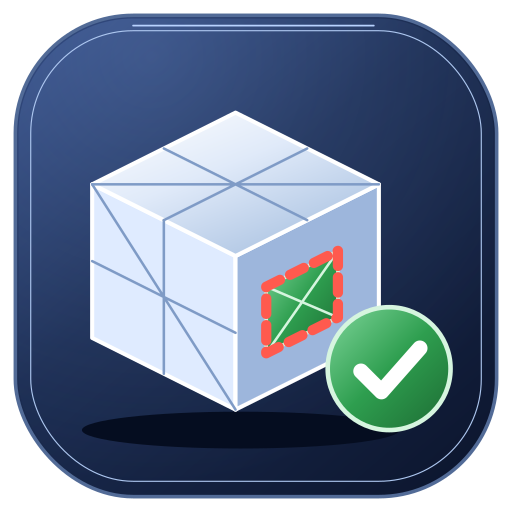
- Watertight: every edge is shared by exactly two triangles facing the same way. Slicers need this to know what is inside the part.
- Open edges are holes in the surface; non-manifold edges are shared by three or more triangles; flipped faces point inward. Most slicers repair small problems on import, but a clean mesh slices predictably.
- Separate bodies are pieces that don’t touch. Several bodies in one STL is normal for print-in-place parts and plates of parts.
- Overhang area is surface facing down at more than 45° from vertical, not counting the face on the bed. It’s a rough guide to where supports may be needed.
Units
Why a model comes in at the wrong size
STL and OBJ files store bare numbers with no unit. Slicers assume millimetres, so a model made in inches arrives 25.4 times too small, and one exported from Blender in metres arrives 1,000 times too small. 3MF states its unit (micron, millimetre, centimetre, inch, foot or metre), and this tool reads it.
| Made in | Set “File units” to | Size change |
|---|---|---|
| Inches (many US CAD exports) | Inches | × 25.4 |
| Centimetres | Centimetres | × 10 |
| Metres (Blender’s default) | Metres | × 1,000 |
Questions, answered
Will I be able to edit the STEP like a CAD model?
Partly. You can measure it, cut it and add features to it, but curved areas are made of flat facets, so they can’t be edited as true curves.
Why is the STEP file so big?
STEP stores every face, edge and vertex with its geometry. Flat areas are merged to keep it small, but curved and organic shapes still produce one face per triangle.
Is my file uploaded?
No. It is converted in your browser.
Sources
Print advice is a starting point drawn from these references, checked on 2026-11-07. Community posts are one maker's experience, not a specification.
- STEP-file, ISO 10303-21 Library of Congress
- STL (STereoLithography) File Format Family Library of Congress
- 3MF Core Specification 3MF Consortium