























































































































































The method
Check, repair and download
A printable model must be a closed, outward-facing surface: every edge shared by exactly two triangles, and nothing passing through itself. Exports, scans and booleans often break that. This tool checks the mesh, makes each repair you choose, and shows the counts before and after. It all runs in your browser; the file is never uploaded.
- Open your model, or try the broken sample. The check lists every fault found.
- Choose the repairs. All are on by default. Each one explains what it changes.
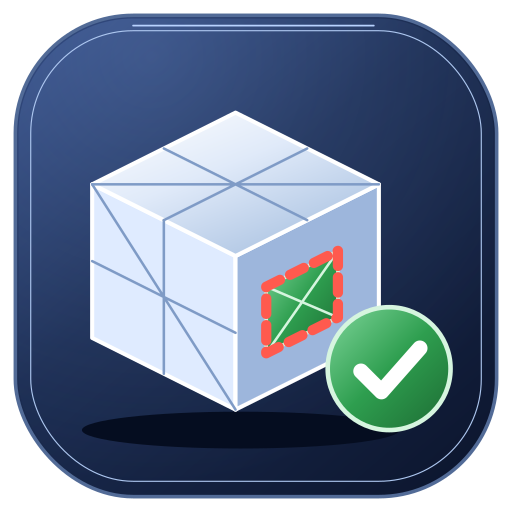
- Look at the preview. Switch between before and after. Open edges are red, flipped faces orange, filled holes green.
- Simplify if you like, to a share or a count of triangles, or merge flat areas only.
- Download a binary STL, 3MF or OBJ, named after your file with “-repaired”.
Repairs
What each repair fixes
| Fault | What it looks like | What the repair does |
|---|---|---|
| Open edges and holes | An edge used by only one triangle. A closed loop of them is a hole. Slicers may fill a hole badly, or print the part hollow or not at all. | Fills each hole up to the size you set. Bigger holes stay open and are listed. |
| Cracks | Two edges that should be one, a hair apart. Common in files written one triangle at a time. | Joins points closer than the tolerance, which closes the crack. |
| Flipped faces | A triangle facing into the part. Its neighbours run the other way along the shared edge. | Turns it to agree with its neighbours, then turns the whole shell to face out. |
| Inside-out shells | A whole shell faces in, so its volume comes out negative. | Turned the right way. A hollow inside another shell is meant to face in, and is kept so. |
| Doubled triangles | The same three points twice. | Copies are dropped. A back-to-back pair between two touching solids is an inner wall; both go and the solids join. |
| Collapsed triangles | A triangle with no area: two points the same, or all three in a line. | Removed. A zero-area triangle in a crack is replaced by splitting its neighbour. |
| Shared edges and points | Two solids that touch at one edge or point. Slicers can’t tell which side is inside. | Gives each solid its own copy of the edge or point, moved 0.001 mm apart. |
| Floating specks | Tiny loose pieces, often left over from a scan or a boolean. | Removed below the size you set. The largest piece always stays. |
| Triangles passing through each other | Overlapping parts of the surface, such as two solids pushed together and not joined. | Counted and shown in purple, not fixed. Most slicers join overlapping shells when they slice; a clean fix needs solid boolean operations in a CAD or mesh program. |
- Fixed order. The repairs run in the order listed, because each makes the next one work: joined points first, then cleaning, then facing, then holes.
- Your shape stays. Apart from filled holes, removed specks and the 0.001 mm split, no point moves.
Simplify
Fewer triangles, same shape
| Setting | What you get | Good for |
|---|---|---|
| Reduce to a share | The share of triangles you pick, with the cheapest collapses made first | Huge scans and sculpts, for a smaller file that slices faster |
| Reduce to a count | A set number of triangles | Sites and programs with a triangle limit |
| Merge flat areas only | Fewer triangles on flat faces; curved areas and the shape are unchanged | CAD exports with many thin triangles on flat faces |
Simplifying uses quadric error edge collapse, from Garland and Heckbert’s 1997 paper. Each point keeps a running sum of its squared distances to the planes of its triangles. The edge whose collapse adds the least error goes first, and the merged point goes where that error is lowest. Edges of holes, and edges sharper than the angle you set, add planes of their own, so outlines and creases stay put. A collapse is refused when it would fold a triangle over or pinch the surface, so a closed model stays closed.
After simplifying, the tool measures how far the new surface is from the old one, both ways, at up to 20,000 points on each, and shows the largest distance found.
Printing
Before you slice
- Check the after column. Zero open edges, zero shared edges and zero flipped faces is what slicers need.
- Big holes. A filled hole is flat or gently curved. If the hole was in a curved surface, the patch may show as a flat spot; sand it or fix it in a mesh program.
- Overlapping shells usually slice fine, because most slicers join them. If yours doesn’t, join them with a boolean union in a CAD or mesh program.
- Simplify last. Print a small test first if the deviation shown is more than about a layer height.
Limits
What this tool doesn’t do
- No booleans. Triangles passing through each other are counted, not cut away. A heavily self-intersecting mesh needs a solid rebuild in a mesh program.
- No remeshing. Filled holes aren’t smoothed to follow the surface around them.
- Up to about 4 million triangles in a browser tab. Simplifying a very large model can take a minute.
- One model. A 3MF or OBJ with several objects is joined into one model; colours and object names aren’t kept.
- Some faults can’t be untangled. An edge shared by an odd number of triangles has no clean inside and outside; it is left and listed.
Questions, answered
Is it free?
Yes. Every repair and download is free, with no account and no limit on files.
Is my file uploaded?
No. The model is read, repaired and written by your browser, on your device. Nothing is sent to 3Dprintsy or anyone else.
Will the repaired model fit my printer?
Repairs don’t change the size. The preview and the check show the size in millimetres.
Can I sell what I print from it?
The repaired file is still your model, so what you may do with it depends on the model’s own licence. 3Dprintsy claims nothing over the files this tool makes.
Why are there still problems after repair?
Triangles passing through each other aren’t fixed, and holes bigger than your size limit are left open. Raise the hole size, or fix overlaps with a boolean union in a mesh program.
Why did the volume change?
Filling holes adds the missing surface, removing an inner wall joins two solids, and turning an inside-out shell makes its volume count the right way. All of these change the volume figure.
What tolerance should I use?
Leave it at 0.01 mm for files from CAD and modelling programs. Raise it slowly for scans with gaps; too high a value can join points that belong apart, such as two sides of a thin slot.
Sources
Print advice is a starting point drawn from these references, checked on 2026-11-12. Community posts are one maker's experience, not a specification.
- Surface Simplification Using Quadric Error Metrics (SIGGRAPH 1997) Michael Garland and Paul S. Heckbert, Carnegie Mellon University
- Filling Holes in Meshes (Symposium on Geometry Processing 2003) Peter Liepa, Eurographics Association
- Fast, Minimum Storage Ray-Triangle Intersection (1997) Tomas Möller and Ben Trumbore, Cornell University
- 3MF Core Specification: meshes, vertices and triangles 3MF Consortium