Powder bed fusion spreads a thin layer of powder, fuses only the regions that belong to the part, and repeats. NIST's ASTM-derived definition is a process that uses thermal energy from a laser or electron beam to selectively fuse powder in a powder bed. The ISO/ASTM 52900 abbreviation is PBF.
The family has two very different branches. Polymer machines, such as selective laser sintering (SLS) and HP's Multi Jet Fusion (MJF), make nylon and other plastic parts without support structures. Metal machines, sold as DMLS, SLM or laser powder bed fusion (LPBF), and electron beam melting (EBM) produce dense metal parts for aerospace, medical and industrial use, but need supports, controlled atmospheres and heat treatment.
How a part is made
- Pack and slice: software arranges parts in the build volume and slices them into layers.
- Spread powder: a blade or roller spreads a thin layer of powder across the build platform.
- Fuse the layer: a laser or electron beam scans the cross-section, or in MJF, printheads jet agents and lamps heat the layer.
- Lower and repeat: the platform drops by one layer and fresh powder is spread over the last layer.
- Cool the build, in the machine or a separate station, to limit warping.
- Recover parts from the loose powder, recycle unfused powder, and cut metal parts from their supports.
- Finish: blast, dye or smooth polymer parts; stress relieve, heat treat and machine metal parts as required.
One family, several names
The name differences are partly technical and partly branding. Loughborough University's Additive Manufacturing Research Group lists DMLS, EBM, SHS, SLM and SLS as powder bed fusion variants. EOS says DMLS follows the principle of Direkt Metall Laser Schmelzen, which it translates as direct metal laser melting, and calls it a laser powder bed fusion (LPBF) technology. Desktop Metal's guide likewise treats L-PBF, SLM and DMLS as names for the same metal process.
HP's process guide still draws the older distinction, describing DMLS as sintering metal without fully liquefying it and SLM as full melting. When you compare machines or service quotes, ask about the material, energy source and atmosphere rather than relying on the acronym.
| Process | Energy source | Typical materials | Notes |
|---|---|---|---|
| SLS (selective laser sintering) | Laser | Nylon 12, nylon 11, TPU and other polymers | No supports; powder preheated just below its melting point |
| MJF (Multi Jet Fusion) | Jetted fusing and detailing agents plus heat | Nylon and other polymers | HP's process; agents are printed across a full layer at once |
| DMLS, SLM or LPBF | Laser in an inert gas atmosphere | Titanium, aluminum, nickel alloys, cobalt-chrome, steels, copper | Needs supports and stress relief |
| EBM (electron beam melting) | Electron beam in a vacuum | Titanium, cobalt-chrome and other conductive metals | Hot process; Colibrium says supports are reduced |
| SHS (selective heat sintering) | Heated thermal print head | Thermoplastic powder such as nylon | Low-power niche process, mainly for concept models |
Polymer SLS
In SLS, the powder bed is preheated to just below the polymer's melting point, so the laser only has to add a little energy to fuse each cross-section. Formlabs says temperature must be held within about 2 °C through preheating, sintering and cooling to limit warping, and gives layer thicknesses of 50 to 200 microns. Loughborough notes that the chamber is often filled with nitrogen.
Because loose powder surrounds every part, SLS needs no support structures. Parts can be packed through the full height of the build, and interlocking or moving parts and internal channels can be printed in one piece. The costs are time and powder management. Formlabs says cooling can take up to half the print time, and because unsintered powder degrades slightly each time it is heated, every job has to mix in some fresh powder, a ratio known as the refresh rate.
Multi Jet Fusion
HP's Multi Jet Fusion replaces the laser with inkjet printing and heat. After the powder is spread, printheads deposit a fusing agent where the part should form and a detailing agent around it, at voxel level. HP says the fusing agent marks the areas to fuse and the detailing agent protects areas from fusion, giving sharper edges. Heat is then applied across the bed and the treated areas fuse.
Because the agents are printed across the whole layer with HP's PageWide printheads, the time per layer does not depend on how much area is fused, unlike a laser that sinters point by point. HP classes MJF as combining aspects of powder bed fusion and binder jetting, but stresses that it fuses the polymer rather than gluing particles together. HP lists functional uses such as end-of-arm tooling, jigs and fixtures, orthotics and prosthetics, and automotive components.
Metal laser powder bed fusion
Metal LPBF uses higher-power lasers and an inert gas atmosphere, according to EOS, to melt fine metal powder at the points defined by the CAD model. The thin layers give good detail, but each spot heats and cools very quickly. Desktop Metal notes that this rapid thermal cycling creates thermal stress and direction-dependent properties, so parts are typically stress relieved, which it says takes several hours at 400 to 800 °C.
Unlike polymer SLS, metal parts need supports. HP's guide says both DMLS and SLM require them, and Desktop Metal explains that they act as thermal anchors as well as structural ones; they are often removed with wire EDM or milling. Loughborough lists hot isostatic pressing as a way to raise density further. EOS says its portfolio covers more than 35 alloys, and its powder catalog includes AlSi10Mg aluminum, Ti64 titanium, IN718 and IN625 nickel alloys, cobalt-chrome, CuCrZr copper alloy, maraging steel and 316L and 17-4PH stainless steels.
Electron beam melting
EBM uses an electron beam instead of a laser and must run in a vacuum; Loughborough cites about 1 × 10⁻⁵ mbar on an Arcam machine. GE acquired Arcam in 2016 and retired the Arcam EBM brand in 2024, when GE Additive became Colibrium Additive. Colibrium says the combination of a fast electron beam and elevated build temperatures cuts thermal stress sharply compared with laser printing and removes the need for heavy support structures.
The hot process changes how a build is packed. Colibrium says its machines can stack parts through the full build height, sometimes without supports between them, and that some systems routinely print more than 150 acetabular cups for hip implants in one run. It also highlights crack-prone alloys such as titanium aluminide. Desktop Metal notes that the powder around EBM parts is partly sintered and acts as some mechanical support, but that EBM still needs thermal supports in many designs.
Choosing a powder bed process
For polymer parts, SLS and MJF compete directly. Both make functional nylon parts without supports, and HP says MJF gives high throughput and good isotropy. EOS says SLS is the only technology that produces truly white parts. In practice the choice usually comes down to the materials offered, part size, finish and price from the printer or service you use.
For metal, Desktop Metal calls laser powder bed fusion one of the most common methods for printing high-value metal parts today. Loughborough notes that EBM is used for aerospace parts and medical implants. When volumes are high and parts are small, binder jetting followed by sintering is an alternative, and for very large metal structures, Sciaky's wire-fed EBAM and other directed energy deposition processes build faster with coarser detail.
At a glance
Strengths
- Polymer parts need no supports, so nesting and complex geometry are easy
- Strong, functional nylon parts and dense metal parts
- Wide range of qualified metal alloys
- Efficient for batches of small parts
Limitations
- Expensive machines with demanding facility needs
- Long cooling times and careful powder handling
- Grainy surfaces that depend on powder size
- Metal parts need supports, stress relief and machining
Typical applications
- Functional nylon prototypes and end-use parts
- Jigs, fixtures and robot end-of-arm tooling
- Orthopedic implants
- Aerospace and turbomachinery components
- Orthotics and prosthetics
Materials for this process
- PA12 powder
- PA11 powder
- TPU powder
- Glass-filled PA12 powder
- AlSi10Mg aluminum
- Ti-6Al-4V titanium
- Cobalt-chromium alloy
- Nickel alloy 718
- Nickel alloy 625
- Copper
- CuCrZr copper alloy
- 316L stainless steel
- 17-4 PH stainless steel
- Low-expansion nickel-iron alloy
- Maraging steel
96 printers in the catalog
Profiles in this family, by the process name each manufacturer uses: LPBF (56), SLS (16), EB-PBF (10), LPBF + milling (4), Micro laser sintering (3), MJF (3), Metal PBF (2), SAF (1), EB-PBF (NeuBeam) (1).
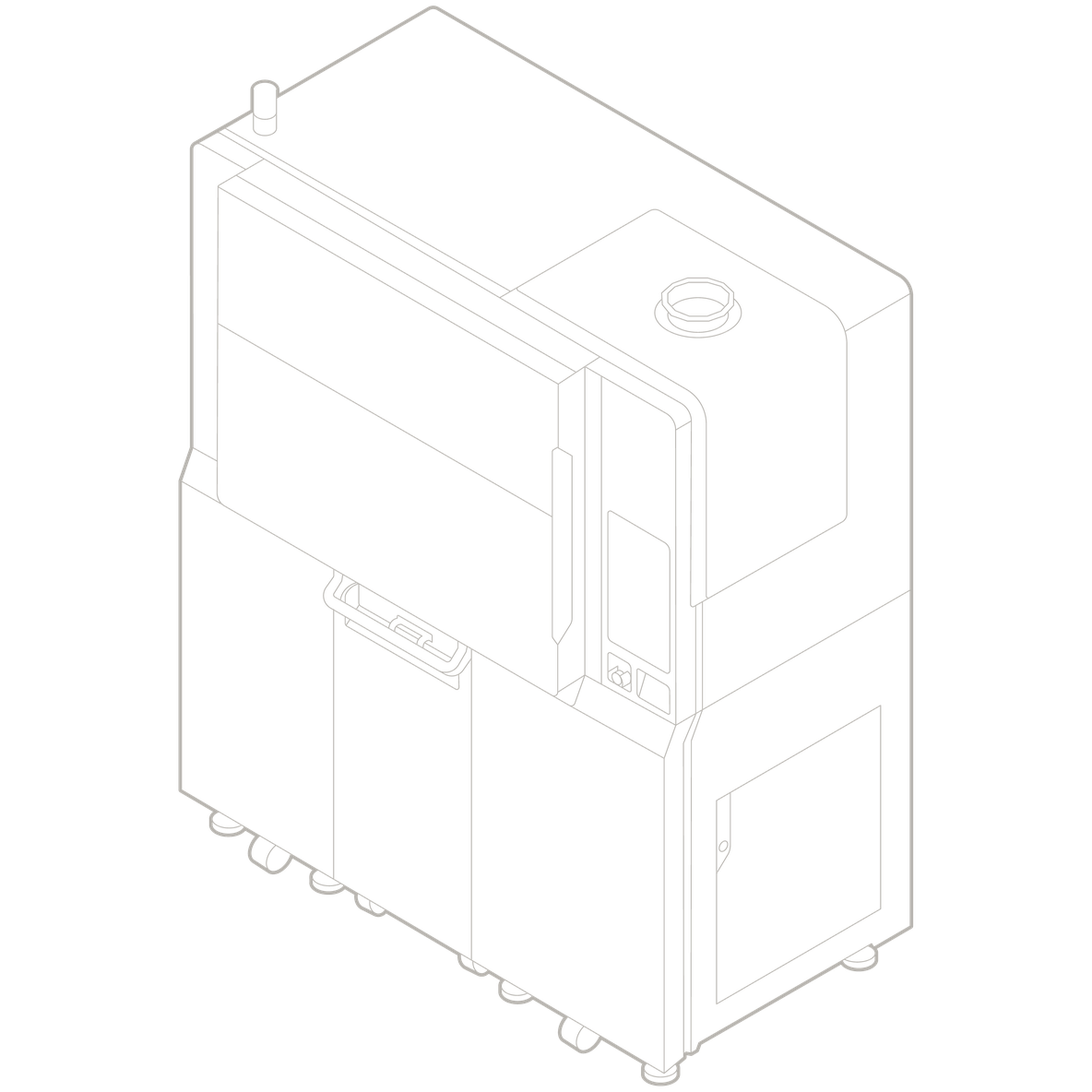
Fuse X1
Official Fuse X1 technical illustration, not a photograph.
Common questions
What is the difference between SLS and MJF?
Both fuse polymer powder in a bed and need no supports. SLS uses a laser to sinter each cross-section point by point. MJF, HP's process, prints fusing and detailing agents across the whole layer and then applies heat, so the time per layer does not depend on how much area is fused.
Are DMLS and SLM the same thing?
In current use they describe the same process: a laser melting metal powder in an inert atmosphere. EOS says its DMLS name stands for direct metal laser melting and calls it LPBF, and Desktop Metal treats DMLS, SLM and L-PBF as equivalent. Some older sources still describe DMLS as partial sintering.
Why do SLS parts not need supports when metal parts do?
In SLS the bed is held just below the polymer's melting point and the loose powder holds parts in place. In metal LPBF the melt pool heats and cools very quickly, so supports are needed to anchor parts and conduct heat away and to resist distortion from thermal stress.
Can unused powder be reused?
Yes, with limits. Formlabs explains that unsintered nylon powder degrades slightly each time it is heated, so each SLS build mixes recovered powder with a share of fresh powder, called the refresh rate. The right ratio depends on the material and machine, so follow the manufacturer's guidance.
Sources
- Costs and Cost Effectiveness of Additive Manufacturing (process definitions, section 2.1) NIST · Checked 2026-10-15
- Additive Manufacturing Technologies NIST · Checked 2026-10-15
- A Comprehensive Overview of Additive Manufacturing Processes Through a Time-Based Classification Model (Koltsaki and Mavri, 2024) 3D Printing and Additive Manufacturing, via PubMed Central · Checked 2026-11-02
- Powder Bed Fusion Loughborough University Additive Manufacturing Research Group · Checked 2026-11-02
- DMLS Metal 3D Printing EOS · Checked 2026-11-02
- What Is A Powder Printer? How Powder 3D Printing Is Changing the Manufacturing Landscape EOS · Checked 2026-11-02
- The Ultimate Guide to Laser-Free Metal 3D Printing (binder jetting) Desktop Metal · Checked 2026-11-02
- Introduction to 3D printing processes HP · Checked 2026-11-02
- Comparing Binder jetting, Material Jetting, Multi Jet Fusion and SLS HP · Checked 2026-11-02
- Selective Laser Sintering (SLS): Complete Guide Formlabs · Checked 2026-10-15
- Metal material portfolio EOS · Checked 2026-10-17
- Metal powder grades EOS · Checked 2026-10-17
- Metal powders (catalog page 2) EOS · Checked 2026-11-02
- GE Additive rebrands as Colibrium Additive GE Aerospace · Checked 2026-11-02
- Enabling Metal Additive Production Using Electron Beam Melting Technology (EBM Anthology) Colibrium Additive · Checked 2026-11-02
- Metal Additive Manufacturing with EBAM Technology Sciaky · Checked 2026-11-02
An explainer synthesized from the cited references, not hands-on testing. Vendor names for processes are trademarks of their owners and are mapped to the ISO/ASTM 52900 families for orientation.