Binder jetting builds parts by printing a liquid binder into a bed of powder. NIST's ASTM-derived definition is a process in which a liquid bonding agent, deposited by an inkjet printhead, joins powder materials in a powder bed. The ISO/ASTM 52900 abbreviation is BJT.
Nothing melts during printing. The printed part is powder held together by binder, which is why the family covers such different results: foundry sand molds that go straight to casting, full-color models, and metal parts that only reach full strength after sintering in a furnace. Desktop Metal says the technology was invented by Ely Sachs at MIT, one of its co-founders, and Loughborough notes the process is often called 3DP.
How a part is made
- Spread a thin layer of powder and, in some machines, compact it.
- Jet binder: an inkjet printhead deposits binder where the layer's cross-section should be.
- Optionally heat or dry the layer, then lower the platform and spread the next layer.
- Cure the build box in an oven so the green parts are strong enough to handle.
- Depowder: remove the parts from the loose powder, which is sieved for reuse.
- Finish according to material: sinter metal parts in a furnace, strengthen other parts, or send sand molds to the foundry.
How a binder jet printer works
The mechanics are close to a document printer. Desktop Metal compares each powder layer to a sheet of paper and the binder to ink, with layers usually 30 to 200 microns thick. A printhead gantry sweeps across the bed, and Loughborough notes that adding nozzles raises speed. Desktop Metal describes the print cycle as depositing, spreading and compacting powder, selectively depositing binder and optionally heating or drying, with details that vary between manufacturers.
Unbound powder surrounds the parts throughout the build, so no support structures are printed, as HP and Loughborough both note. Parts can be nested in three dimensions within the build box. Desktop Metal calls binder jetting one of ASTM's seven recognized additive technologies and says it prints metal, technical ceramics and sand.
Green parts, curing and depowdering
Straight off the printer, a metal part is a green part: metal powder held together by binder. Desktop Metal describes curing the whole build box in an oven, which cross-links the binder and gives the parts enough strength to lift out; without that step, it says, they would be a fragile sandcastle of powder. Many systems cure in a separate oven so the printer can start the next job.
Depowdering removes the loose powder, often with brushes and air guns. Desktop Metal says most reclaimed powder can be sieved and blended with new powder for the next build and cites a study figure of up to 96 percent material efficiency. Green parts are fragile at this stage, and Loughborough notes that parts are often left to cool in the machine before removal for a better finish.
Sintering metal parts
Sintering turns a metal green part into a dense metal part. Desktop Metal explains that the furnace heats parts close to the powder's melting point. Depending on the alloy, densification happens either by solid-state sintering below the solidus or by liquid-phase sintering between the solidus and liquidus. Particles neck together and the voids between them collapse, so the part shrinks.
Shrinkage is the main design challenge, and parts can also sag or distort under gravity and friction at sintering temperature. Desktop Metal says parts may need setters or ceramic supports in the furnace, as in metal injection molding (MIM), and its Live Sinter software scales and pre-distorts geometry so the sintered part ends up on size. HP's Metal Jet follows the same route with MIM-grade stainless steel powder, and HP says the parts reach properties similar to MIM.
Desktop Metal argues that because the shape is formed at low temperature and densified all at once, binder jet parts avoid the thermal stresses of laser melting and develop a fine, equiaxed grain structure with isotropic properties. These are claims from a binder jetting vendor, based on its own and ExOne's research.
Sand, ceramics and full color
Sand binder jetting is a major industrial use. Printed molds and cores go to the foundry without the patterns that conventional sand casting needs. HP lists sand casting molds and cores among binder jetting's main applications, and Desktop Metal's materials list includes natural and synthetic sands for its ExOne machines.
Binder jetting also handles technical ceramics. Desktop Metal lists alumina, aluminum nitride, silicon carbide, boron carbide and tungsten carbide among its materials. Loughborough and HP note that polymer binder jetting can print in color, which made it popular for colored concept and architectural models. Loughborough cautions that parts held only by binder are often unsuitable for structural use and usually need post-processing to strengthen them.
Binder jetting versus laser powder bed fusion
For metal parts, the main alternative is laser powder bed fusion. The table summarizes Desktop Metal's comparison. Because it comes from a binder jetting vendor, weigh it accordingly. Desktop Metal itself acknowledges that EBM can sometimes beat binder jetting for a single part once curing and sintering are counted, and that binder jetting's advantage grows with the number of parts in each build.
| Aspect | Binder jetting | Laser powder bed fusion |
|---|---|---|
| How powder is joined | Liquid binder at low temperature, then furnace sintering | Laser melts powder during the build |
| Supports while printing | None; loose powder holds the parts | Required as thermal and structural anchors |
| Thermal stress | Low during printing; sintering shrinkage must be compensated | Rapid heating and cooling; parts are stress relieved |
| Throughput | Printhead passes cover the bed; many parts per build | Beam scans each part; more parts mean longer builds |
| Support removal | Not needed after printing; furnace setters may be used | Often by wire EDM or milling |
Limitations to plan for
Post-processing takes a large share of the total time, as Loughborough and HP both note. Metal parts need curing, depowdering and a furnace cycle before they are usable, and non-metal parts usually need a strengthening step. Dimensional accuracy depends on how well sintering shrinkage is predicted and supported.
The economics also favor volume. Desktop Metal's own comparison shows binder jetting gaining most when a build is full of parts, because the printhead takes the same number of passes whether the bed holds one part or many. For a single prototype, a laser or electron beam process may finish sooner.
At a glance
Strengths
- No support structures during printing
- Fast, whole-bed printing suited to batches of parts
- Wide material range: metals, sand, ceramics and color
- Low temperature while the part is being shaped
Limitations
- Metal parts shrink during sintering and need compensation
- Green parts are fragile until cured and sintered
- Lengthy post-processing
- Parts held only by binder are weak for structural use
Typical applications
- Sand casting molds and cores
- Small metal production parts
- Tooling
- Full-color models
- Technical ceramic parts
Materials for this process
- Foundry sand
- 17-4 PH stainless steel
- 316L stainless steel
- Nickel alloy 625
- Nickel alloy 718
- Cobalt-chromium alloy
- Copper
- Ti-6Al-4V titanium
- Silicon carbide
- Alumina
- Aluminum nitride
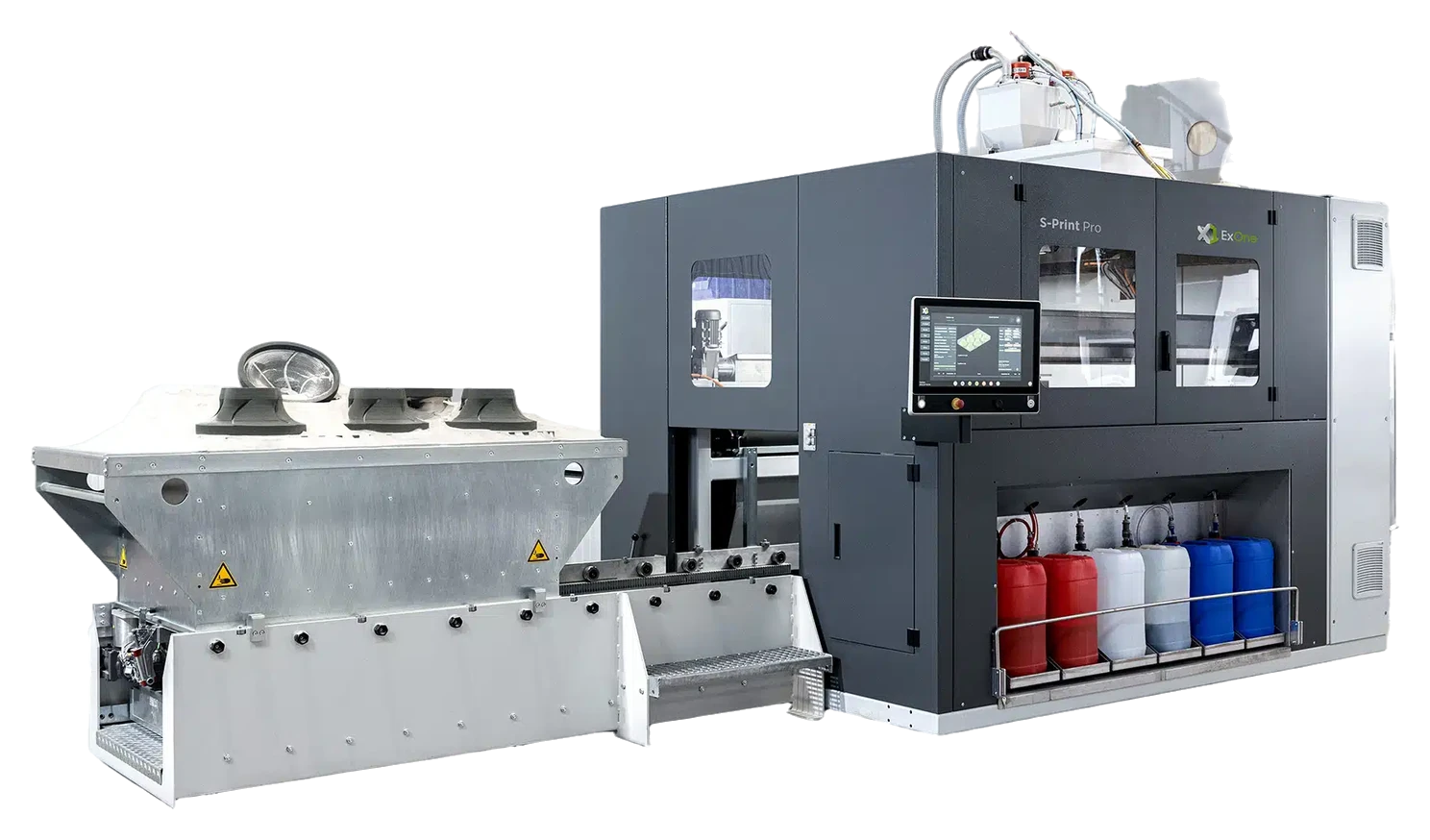
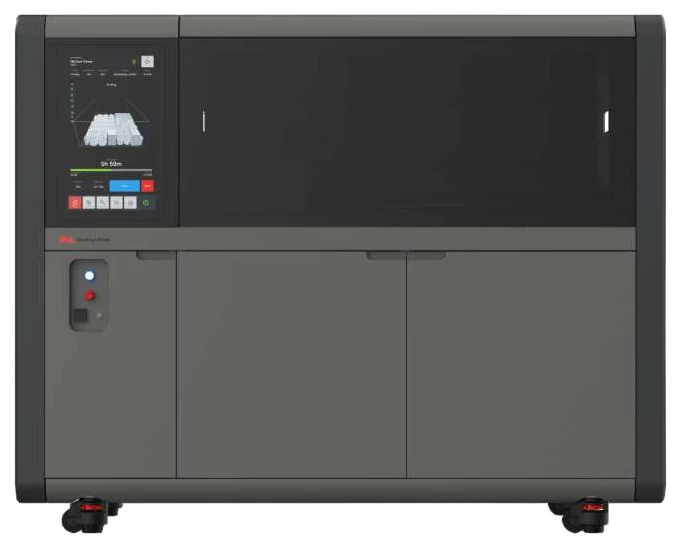
7 printers in the catalog
Profiles in this family, by the process name each manufacturer uses: Sand binder jetting (3), Metal binder jetting (2), Binder jetting (2).
Common questions
Is binder jetting the same as Multi Jet Fusion?
No. Both use inkjet heads over a powder bed, but HP explains that binder jetting uses a single binding agent that glues powder together, while MJF uses fusing and detailing agents and heat to melt polymer powder. MJF parts come out of the printer fused; metal binder jet parts still need sintering.
How much do binder jet metal parts shrink?
Desktop Metal's guide does not give one figure, because shrinkage depends on the powder, binder and sintering cycle. It says parts shrink as particles consolidate and can distort if not designed and supported properly, and that simulation software can scale and pre-distort the geometry so the finished part lands on size.
Are binder jet metal parts fully dense?
Desktop Metal says sintering produces high-density parts that typically exceed gravity castings and meet or exceed standard MIM parts. HP says its Metal Jet parts have properties similar to MIM. These are vendor statements, so check the data sheet for the specific alloy and process.
Sources
- Costs and Cost Effectiveness of Additive Manufacturing (process definitions, section 2.1) NIST · Checked 2026-10-15
- Additive Manufacturing Technologies NIST · Checked 2026-10-15
- A Comprehensive Overview of Additive Manufacturing Processes Through a Time-Based Classification Model (Koltsaki and Mavri, 2024) 3D Printing and Additive Manufacturing, via PubMed Central · Checked 2026-11-02
- Binder Jetting Loughborough University Additive Manufacturing Research Group · Checked 2026-11-02
- The Ultimate Guide to Laser-Free Metal 3D Printing (binder jetting) Desktop Metal · Checked 2026-11-02
- Introduction to the Binder Jetting Process Desktop Metal · Checked 2026-11-02
- Introduction to 3D printing processes HP · Checked 2026-11-02
- Comparing Binder jetting, Material Jetting, Multi Jet Fusion and SLS HP · Checked 2026-11-02
- Additive material portfolio Desktop Metal · Checked 2026-10-17
An explainer synthesized from the cited references, not hands-on testing. Vendor names for processes are trademarks of their owners and are mapped to the ISO/ASTM 52900 families for orientation.