Material extrusion pushes material through a nozzle and lays it down along a programmed path, one layer at a time. NIST's definition, adapted from ASTM, describes machines that push material, typically a thermoplastic filament, through a nozzle onto a platform that moves in horizontal and vertical directions. In the ISO/ASTM 52900 vocabulary the family is abbreviated MEX.
Most people know it as FDM or FFF. According to UltiMaker, Stratasys developed and trademarked Fused Deposition Modeling, and the RepRap project introduced Fused Filament Fabrication in 2005 as a generic name for the same process. It is the most common technology in homes, schools and workshops, and it also runs on industrial machines that print high-temperature polymers and fiber-reinforced composites.
How a part is made
- Slice the model: software such as PrusaSlicer or UltiMaker Cura cuts it into layers and plans the walls, infill, supports and nozzle path.
- Heat the nozzle and bed, and feed filament from the spool into the hot end, where it softens and melts.
- Deposit the first layer: the nozzle traces the outline and fill of the first slice onto the build plate.
- Build upward: after each layer the platform drops (or the head rises) by one layer height, and the next layer bonds to the warm layer below.
- Print supports where needed: overhangs rest on breakaway or soluble support material, sometimes from a second nozzle.
- Finish the part: remove supports, then sand, fill, paint or machine critical surfaces if required.
FDM, FFF and the standard name
The names cause more confusion than the technology. UltiMaker says Stratasys developed and trademarked FDM in 1989 and that RepRap coined FFF in 2005 as a non-trademarked alternative. The difference is origin, not mechanism, and the terms are used interchangeably. HP's process guide makes the same point: FDM is trademarked and FFF is not. Both sit in the material extrusion family.
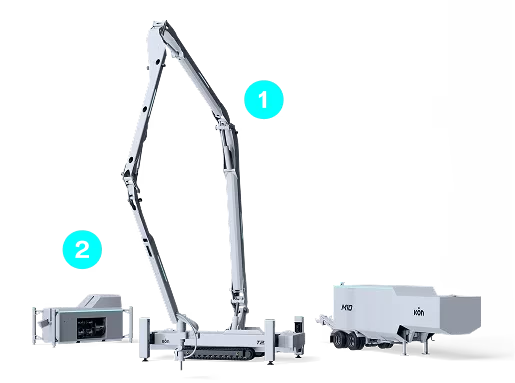
The family is broader than plastic filament. UltiMaker notes that food and biological pastes can be extruded, though this is mostly experimental, and that very large machines are being developed for construction materials such as concrete. Markforged's continuous fiber reinforcement adds a second nozzle that lays long strands of carbon fiber, fiberglass or Kevlar inside a part printed from a thermoplastic base. All of these build by forcing material through a nozzle along a path.
Inside the printer
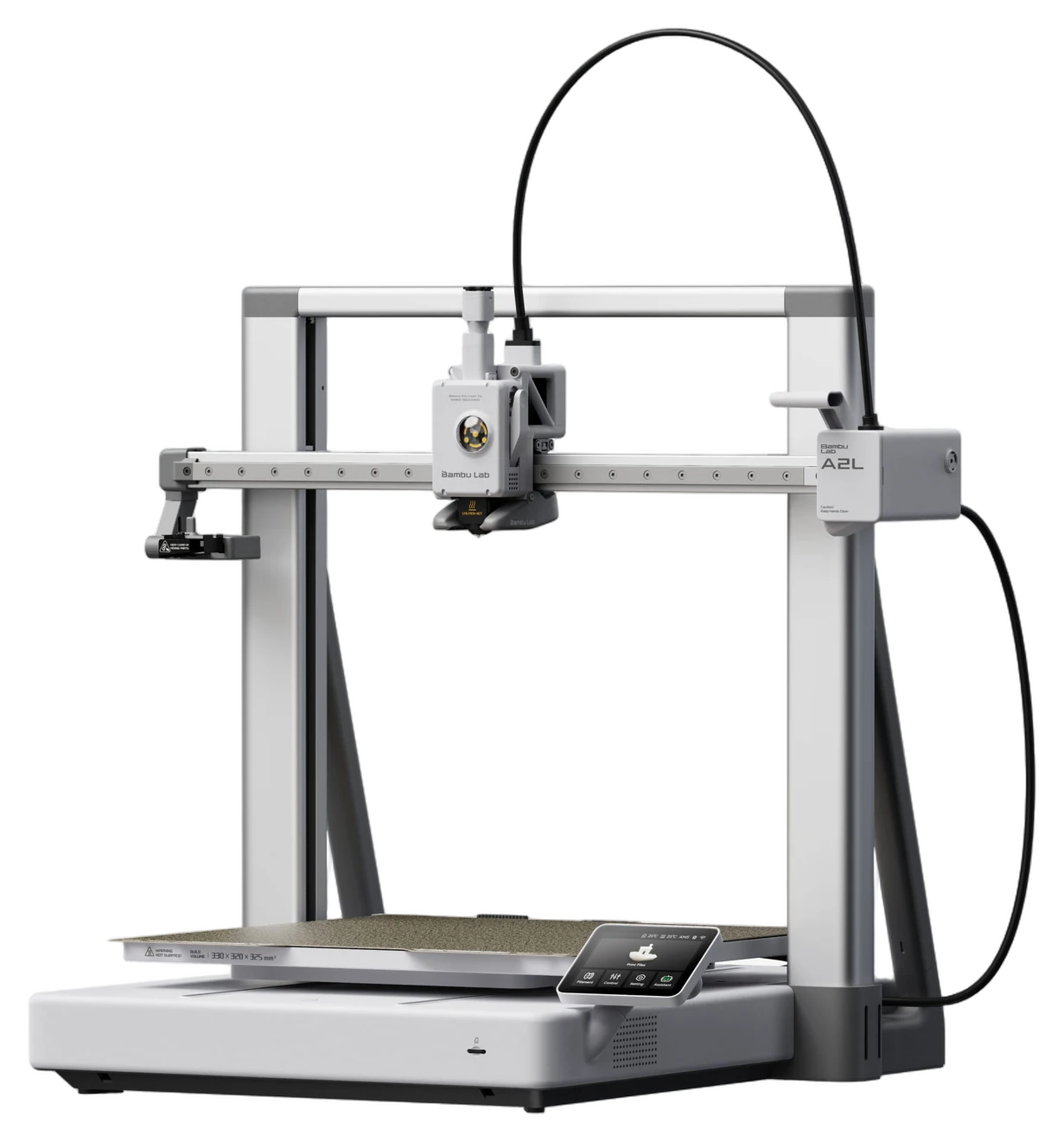
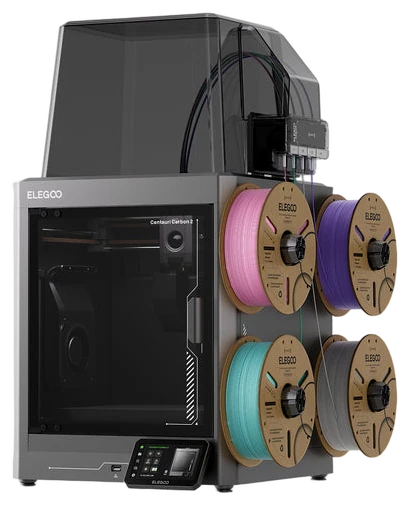
A filament printer has an extruder that grips and pushes the filament, a hot end that melts it, a nozzle, a build platform and motors that move them. UltiMaker describes the print head riding on a stepper-motor gantry with one or two nozzles. Prusa lists Cartesian, CoreXY, Delta and Polar layouts, which differ in how the nozzle and bed move. Filament is usually 1.75 mm in diameter, occasionally 2.85 mm, and UltiMaker says spools typically hold 250 g to 1 kg.
Loughborough University's Additive Manufacturing Research Group points out what sets extrusion apart from other families: material flows continuously through the nozzle under pressure, so pressure and speed must stay steady for accurate results. Each new line of plastic bonds to the one below because it is still molten when it lands. That is why temperature, cooling and flow calibration have such a strong effect on print quality.
Resolution, accuracy and finish
The nozzle sets a floor on detail. Loughborough notes that a round nozzle cannot make perfectly square features and that accuracy is limited by nozzle size. Layer height, the thickness of each slice, controls how visible the steps are on curved and sloping surfaces. UltiMaker lists lower resolution and visible layer lines among the limits of FDM and FFF compared with resin printing.
Speed and quality pull against each other. Prusa notes that on fast Cartesian printers the weight of a moving axis can reduce quality, which is one reason CoreXY layouts are popular. Larger nozzles and thicker layers shorten print time, while smaller ones improve detail. Loughborough adds that many factors must be controlled for high quality, and that heat-based finishing can shrink parts, which matters when tolerances are tight.
Strength and anisotropy
Extruded parts are strongest along the printed lines and weakest between layers. UltiMaker lists weaker strength along the Z axis as a limitation of the process. If a bracket will be loaded in bending, orient it so the layers run along the load rather than across it, and add walls rather than relying on infill alone.
Industrial systems raise mechanical performance through materials. Stratasys lists ULTEM 9085 (a PEI resin), the PEKK-based Antero 800NA, carbon-filled nylon and ABS, and ASA among its FDM materials, with uses in aerospace, rail interiors and tooling. Markforged's composites data sheet gives a tensile strength of 800 MPa for continuous carbon fiber specimens, against 37 MPa at break for its Onyx base material. Markforged notes those fiber plaques are filled with unidirectional fiber and printed without walls to maximize test results, so real parts will be lower.
Materials
Material choice depends on the printer as much as on the part. UltiMaker notes that some printers are limited to two or three materials or to proprietary filament, and that abrasive composites can cause wear on some machines. High-performance polymers such as PEI and PEKK are mainly offered for industrial systems, as in Stratasys' FDM line.
| Material group | Examples | Why it is used |
|---|---|---|
| Commodity thermoplastics | PLA, PETG, ABS, ASA | Low cost and easy printing; UltiMaker recommends PLA for beginners |
| Engineering thermoplastics | Nylon, PC, TPU, PP | Toughness, heat resistance or flexibility; UltiMaker cites PC heat resistance up to 110 °C |
| High-performance polymers | PEI (ULTEM 9085), PEKK (Antero 800NA) | Heat and chemical resistance for aerospace and industrial parts, per Stratasys |
| Chopped-fiber composites | Carbon-filled nylon, ABS CF10, Onyx | Higher stiffness; can be abrasive to standard nozzles |
| Continuous fiber | Carbon fiber, fiberglass, Kevlar | High strength and stiffness along the fiber path, per Markforged |
| Support materials | PVA, HIPS | Dissolve away from overhangs and cavities (PVA in water, HIPS in d-limonene) |
When to choose material extrusion
Choose extrusion when cost, fast iteration and material choice matter more than fine detail. It suits fixtures, enclosures, brackets, prototypes and large parts. UltiMaker cites Ford saving roughly $1,000 per tool by printing manufacturing aids in-house, and Loughborough notes that for low volumes extrusion can be more economical than injection molding.
Look elsewhere for very fine features, cosmetic surfaces straight off the printer, or complex internal geometry without supports. UltiMaker notes that resin (SLA) printing gives higher resolution and smoother surfaces, and that SLS parts, usually made from nylon powder, are often stronger than FFF parts.
At a glance
Strengths
- Lowest cost to buy and run of the common processes
- Wide material range, from PLA to PEI and fiber composites
- Simple, office-friendly workflow
- Scales from desktop machines to build volumes around 1 m
Limitations
- Visible layer lines and limited fine detail
- Weaker between layers than along them
- Overhangs need support material
- Many settings must be tuned for consistent quality
Typical applications
- Prototypes and concept models
- Jigs, fixtures and manufacturing aids
- Replacement and low-volume end-use parts
- Education and makerspaces
- Aerospace interior parts and composite tooling on industrial systems
Materials for this process
- PLA
- PETG
- ASA
- ABS
- TPU / flexible filament
- Nylon / polyamide
- Polycarbonate blends
- Fiber-filled composites
- PVA / BVOH supports
- Polypropylene (PP)
- HIPS
- PVB
- CPE / copolyester
- Wood-filled polymer
- Decorative metal-filled polymer
- PA6 filament
- PA12 filament
- Carbon-fiber-filled nylon
- Glass-fiber-filled nylon
- PC / ABS blend
- PEEK
- PEKK
- PEI
- PPS
- PPSU
- PSU
- PVDF
- ESD filament
- Flame-retardant filament
- Recycled PLA
- Recycled PETG
- Continuous carbon fiber composite
- Continuous glass fiber composite
- Continuous aramid composite
- Printable concrete
336 printers in the catalog
Profiles in this family, by the process name each manufacturer uses: FFF (282), Extrusion bioprinting (16), Concrete extrusion (14), Pellet extrusion (9), Paste extrusion (7), Food extrusion (3), Bound metal extrusion (2), Continuous fiber extrusion (1), Plastic freeforming (1), Multi-material extrusion (1).
Titan
Manufacturer system overview; numbered equipment callouts are part of the original artwork.
Common questions
Are FDM and FFF different processes?
No. UltiMaker explains that FDM is the name Stratasys trademarked and FFF is the generic term the RepRap project introduced in 2005. Both heat thermoplastic, extrude it through a nozzle and build layer by layer. The standard family name for both is material extrusion.
Why do FDM parts break along the layers?
Each layer bonds to the one below while it is still hot, and that interface is weaker than the continuous plastic within a layer. UltiMaker lists weaker Z-axis strength as a limitation. Orient parts so the main load runs along the layers, and use more walls for strength.
Is carbon-fiber filament the same as continuous fiber?
No. Carbon-filled filaments contain short chopped fibers mixed into the plastic, which mainly add stiffness. Continuous fiber printing, as Markforged describes it, uses a second nozzle to lay unbroken strands of fiber inside the part, replacing infill in chosen layers for much higher strength along the fiber path.
How big can material extrusion printers get?
UltiMaker says FFF build volumes range from about 10 cm per side on small desktop printers to about 1 m on the largest units. Construction printers that extrude concrete are larger still. UltiMaker also notes that large-format machines usually give up some quality compared with smaller, stiffer printers.
Sources
- Costs and Cost Effectiveness of Additive Manufacturing (process definitions, section 2.1) NIST · Checked 2026-10-15
- A Comprehensive Overview of Additive Manufacturing Processes Through a Time-Based Classification Model (Koltsaki and Mavri, 2024) 3D Printing and Additive Manufacturing, via PubMed Central · Checked 2026-11-02
- FDM vs FFF: Understanding 3D Printing Technologies UltiMaker · Checked 2026-11-02
- What is FFF 3D printing? UltiMaker · Checked 2026-11-02
- What is 3D printing? UltiMaker · Checked 2026-11-02
- Introduction to 3D printing processes HP · Checked 2026-11-02
- Material Extrusion Loughborough University Additive Manufacturing Research Group · Checked 2026-11-02
- Types of printers and their differences Prusa Research · Checked 2026-11-02
- FDM Technology Stratasys · Checked 2026-11-02
- Composite materials data sheet Markforged · Checked 2026-10-17
- Additive Manufacturing Technologies NIST · Checked 2026-10-15
An explainer synthesized from the cited references, not hands-on testing. Vendor names for processes are trademarks of their owners and are mapped to the ISO/ASTM 52900 families for orientation.