Sheet lamination makes an object by bonding sheets of material together and cutting each one to the shape of its layer. NIST's ASTM-derived definition is simply a process that uses sheets of material bonded to form a three-dimensional object. The ISO/ASTM 52900 abbreviation is SHL.
It is the least familiar of the seven families, but it covers two very different technologies. Laminated object manufacturing (LOM) and later paper-based printers glue sheets of paper and cut them with a blade or laser, producing low-cost visual models. Ultrasonic additive manufacturing (UAM) welds thin metal foils together without melting them and shapes the stack with a CNC mill, which lets sensors and dissimilar metals be embedded inside solid metal parts.
How a part is made
- Place a sheet of material over the previous layer.
- Bond it: with adhesive, heat and pressure for paper, or ultrasonic welding for metal foil.
- Cut the outline of the layer with a knife, laser or CNC mill; some systems cut the sheet before bonding it.
- Cross-hatch the waste outside the part so it can be separated later, or machine it away.
- Repeat until the stack is complete.
- Remove the excess material (weeding for paper, machining for metal) and finish the part.
Two kinds of sheet lamination
Loughborough University's Additive Manufacturing Research Group groups both technologies under sheet lamination and gives the same basic sequence: position the sheet, bond it over the previous layer, cut the required shape, and add the next layer. Bonding and cutting can be swapped, or the sheet can be cut before it is positioned and bonded. HP's process guide describes the family the same way, with sheets of metal, paper or polymer bonded and then cut or milled.
The two branches differ in almost everything else, from feedstock to the kind of part that comes out, as the table shows.
| Aspect | Paper lamination (LOM, SDL) | Ultrasonic additive manufacturing (UAM) |
|---|---|---|
| Feedstock | Paper sheets, commonly A4 or letter office paper | Metal foil or tape, such as aluminum, copper, stainless steel or titanium |
| Bonding | Adhesive with heat and pressure | Ultrasonic vibration under pressure, without melting |
| Shaping | A blade or laser cuts each layer outline | CNC milling during and after the build |
| Removing waste | Cross-hatched paper is peeled away by hand | Unbonded metal is machined away |
| Typical output | Visual models, including full color | Functional metal parts with embedded features |
Paper-based lamination
Loughborough describes LOM as one of the earliest additive manufacturing techniques. Paper is cheap, widely available and simple to handle, and the cutting tool only follows the outline of each layer rather than filling the whole area, so cutting is fast. The material outside the part is cross-hatched into small blocks so it can be broken away after the build without specialist tools.
Mcor Technologies refined the idea as selective deposition lamination. As Digital Engineering described it in 2014, Mcor's printers used ordinary office paper, bonded each new sheet with adhesive under heat and pressure, cut the outline, and left the excess paper to be peeled away, a step called weeding, with no chemical baths or powder to remove. Color models were printed with water-based ink that soaked into the paper, so sides and overhangs were colored too, and the article says the Mcor IRIS could print more than one million colors.
Loughborough describes LOM parts as mainly aesthetic and visual models with limited structural quality, though they can be sanded, painted or coated with adhesive to improve their appearance.
Ultrasonic additive manufacturing
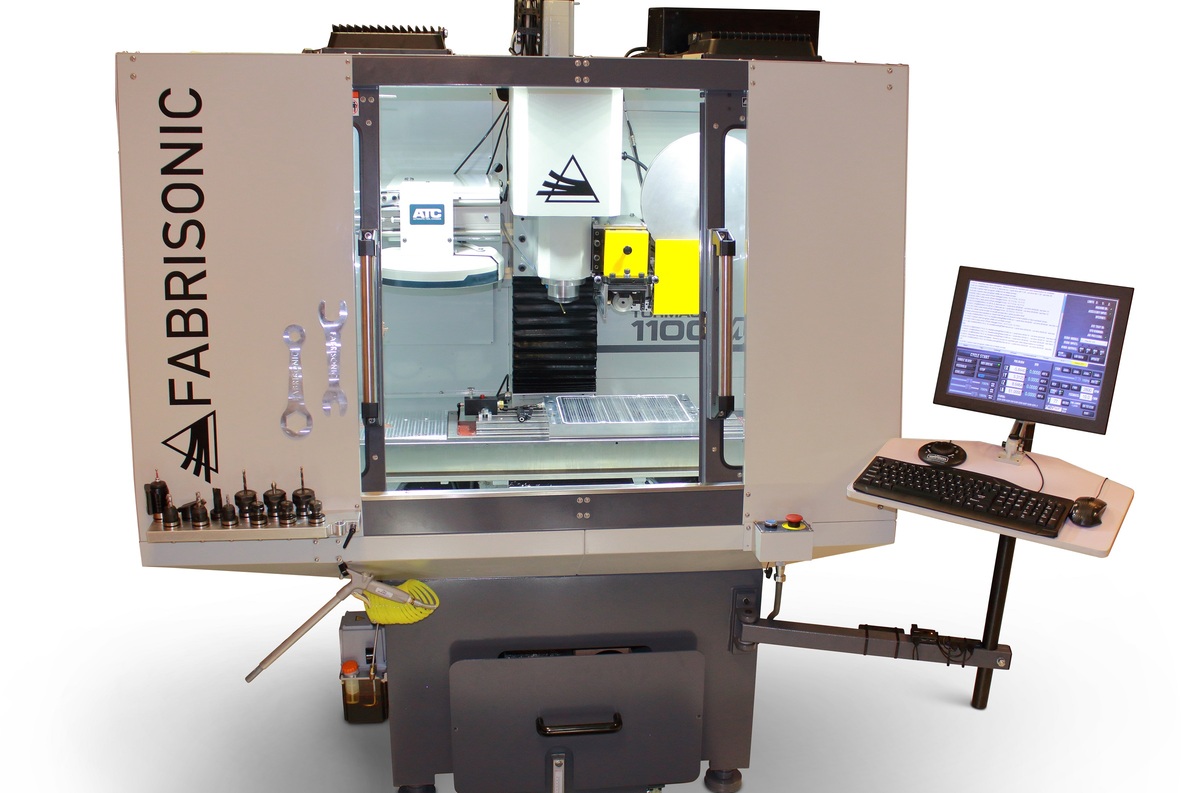
UAM, offered by Fabrisonic, welds layers of metal foil together with high-frequency vibration under pressure. Fabrisonic describes the welds as metallurgical bonds made in the solid state, without heating the metal to its melting point, and builds them on machines that combine the ultrasonic welding head with a 3-axis CNC mill. Foil is welded in overlapping strips across the surface, layers are stacked, and the mill cuts outlines and internal features as the part grows.
Loughborough notes that plastic deformation at the interface increases surface contact and helps the bond form, and that the unbonded metal must be machined away because it cannot be peeled off by hand. It also says that using 0.150 mm thick, 25 mm wide metal tape reduces the amount of material to cut away. Because the process stays cool, Fabrisonic says it can bond dissimilar metals, with examples including aluminum to copper, aluminum to titanium and aluminum to iron.
Embedding sensors and dissimilar metals
Low temperature is UAM's main selling point. Fabrisonic says CNC milling can open pockets for electronics and sensors such as optical fibers and thermocouples, which are then covered by further welded foil, and that fibers and meshes can be embedded to form metal matrix composites. Embedded electronics need insulation, and Fabrisonic warns that the downforce and vibration of welding can damage them.
Fabrisonic notes that the process cannot bond metal directly to non-metals. Its applications include heat exchangers, cold plates and radio frequency devices, much of it in aluminum, where machining can create internal channels and geometries before the next foil layers close them over. Loughborough similarly highlights internal geometries, overhangs and embedded wiring as UAM capabilities, along with relatively low energy use.
Strengths and limits of the family
Sheet lamination's strengths are speed, low material cost and easy handling. Loughborough notes that cutting is fast because only the outline is traced, and that LOM post-processing is quick and needs no specialist tools. UAM adds solid-state joining of metals, which avoids the melting and solidification involved in powder and wire metal processes.
The limits are material choice and part properties. Loughborough lists a limited material range and variable finishes that often need post-processing, and says LOM parts are not suited to structural use because their strength depends on the adhesive. HP describes sheet lamination as mostly used for visual models, with limited materials and finish and strength that vary. For metal, UAM is a specialist process chosen for what it can embed, not as a general replacement for machining.
At a glance
Strengths
- Low-cost, easy-to-handle feedstock
- Fast cutting, since only outlines are traced
- UAM joins metals without melting, so sensors and dissimilar metals can be embedded
- Paper models can be printed in full color
Limitations
- Limited material choice
- Paper parts are weak and mainly visual
- UAM needs CNC machining to remove unbonded metal
- Finishes vary and often need post-processing
Typical applications
- Architectural and concept models
- Full-color visual prototypes
- Aluminum heat exchangers and cold plates
- Metal parts with embedded sensors or fibers
2 printers in the catalog
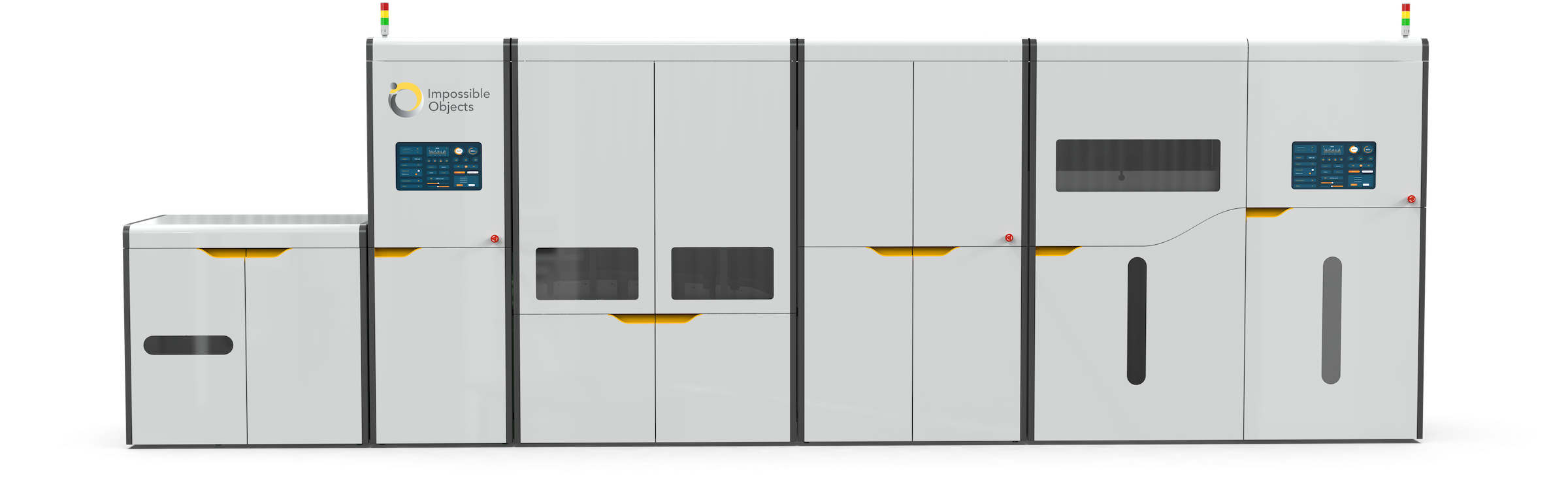
Profiles in this family, by the process name each manufacturer uses: Ultrasonic sheet lamination (1), Composite-based additive manufacturing (1).
Common questions
What is the difference between LOM and UAM?
Both build parts from stacked sheets. LOM glues sheets of paper together and cuts each outline with a knife or laser, giving visual models. UAM, as Fabrisonic describes it, welds metal foil layers with ultrasonic vibration and shapes them with a CNC mill, giving functional metal parts.
Does ultrasonic additive manufacturing melt the metal?
No. Fabrisonic describes UAM as a solid-state process that forms metallurgical bonds without heating the metal to its melting point. Loughborough explains that ultrasonic vibration and pressure deform the metal at the interface and increase contact. The low temperature is what allows sensors and dissimilar metals to be embedded.
Can sheet lamination make functional parts?
Paper parts are mainly for visual models; Loughborough notes their strength depends on the adhesive and is limited. Metal parts made by UAM are functional, and Fabrisonic lists heat exchangers, cold plates and radio frequency devices among its applications.
Sources
- Costs and Cost Effectiveness of Additive Manufacturing (process definitions, section 2.1) NIST · Checked 2026-10-15
- A Comprehensive Overview of Additive Manufacturing Processes Through a Time-Based Classification Model (Koltsaki and Mavri, 2024) 3D Printing and Additive Manufacturing, via PubMed Central · Checked 2026-11-02
- Sheet Lamination Loughborough University Additive Manufacturing Research Group · Checked 2026-11-02
- The 7 categories of Additive Manufacturing Loughborough University Additive Manufacturing Research Group · Checked 2026-11-02
- Introduction to 3D printing processes HP · Checked 2026-11-02
- How Paper-Based 3D Printing Works: The Technology and Advantages (2014) Digital Engineering · Checked 2026-11-02
- What is UAM? Fabrisonic · Checked 2026-11-02
An explainer synthesized from the cited references, not hands-on testing. Vendor names for processes are trademarks of their owners and are mapped to the ISO/ASTM 52900 families for orientation.