Vat photopolymerization builds parts by selectively hardening liquid resin with light. NIST describes the process as curing photopolymer resin with ultraviolet light, and the ASTM-derived definition in NIST's 2014 cost report is machines that selectively cure a liquid photopolymer in a vat using light. ISO/ASTM 52900 abbreviates the family VPP.
The everyday names describe the light source. SLA uses a laser to trace each layer, DLP projects a whole layer at once from a chip of tiny mirrors, and masked SLA (MSLA, also called LCD printing) shines LEDs through an LCD that blocks light except where the layer should cure. HP's process guide also lists continuous variants such as CDLP and CLIP. Resin printing is known for fine detail and smooth surfaces, paid for with cleaning and curing work after every print.
How a part is made
- Prepare the file: orient the model, add supports and slice it in the printer's software, such as Formlabs' PreForm.
- Position the platform so that one layer's thickness of liquid resin sits between it (or the previous layer) and the light.
- Expose the layer: a laser, projector or masked LED array cures the cross-section.
- Separate and recoat: the platform moves so fresh resin flows into place, and the next layer is exposed.
- Wash the finished parts in isopropyl alcohol or another recommended solvent to remove uncured resin.
- Post-cure with light, and heat for some materials, then remove supports and sand the marks.
How light turns resin into a solid
Printing resins are thermosets. Formlabs describes them as mixtures of monomers and oligomers that link into rigid or flexible solids when exposed to particular wavelengths of light. Desktop machines commonly use 405 nm light: Formlabs cites 405 nm for its Form 4, and Prusa lists 405 nm resins for the SL1S. Because curing is a chemical reaction rather than melting, Formlabs says the process runs near room temperature and avoids the thermal distortion of heat-based processes.
A freshly printed layer is not fully reacted. Formlabs says layers remain partly reactive until the final cure, which helps them bond chemically to each other and gives more uniform properties in all directions than extruded parts. Loughborough University's Additive Manufacturing Research Group notes that parts often need post-curing to be strong enough for structural use.
Top-down and bottom-up machines
Many early and large-format systems work top-down. The platform sits just below the resin surface, light comes from above, and the platform moves down after each layer. Loughborough describes this layout, including a blade that can sweep the resin surface smooth between layers. Formlabs notes that large-format DLP machines are mostly top-down, and Loughborough cites a 3D Systems ProX 950 with a 1,500 × 750 × 550 mm build area.
Most desktop printers are inverted, or bottom-up. Light shines up through a transparent tank floor, the part hangs upside down from the platform, and the platform lifts after each layer so resin flows back underneath. Formlabs says its co-founders introduced this layout in 2011. The challenge is the peel force that pulls each new layer off the tank floor. Formlabs' flexible tanks and Prusa's tilting vat are both designed to reduce it.
Laser, projector or LCD
All three light engines belong to the same family and use similar resins. The differences show up in speed, build size, cost and maintenance. TI, which makes the micromirror chips used in DLP, says a DLP printer exposes an entire layer in one shot, so print speed does not depend on how many parts are on the platform. Prusa makes the same point for DLP and MSLA, while laser SLA time depends on the area being cured. The SLA vs DLP vs MSLA comparison covers resolution in more depth.
| Engine | How a layer is exposed | What sets XY detail | Main trade-off |
|---|---|---|---|
| Laser SLA | A laser spot, steered by mirrors, traces the cross-section | Spot size and beam positioning precision | Time per layer grows with the area being cured |
| DLP | A projector flashes the whole layer from a micromirror chip | Number of mirrors spread over the build area | Pixels get larger as the build area grows |
| MSLA or LCD | LEDs shine through an LCD mask showing the layer image | LCD pixel size and how parallel the light is | LCDs pass only part of the UV and are replaced over time |
Supports, orientation and failures
Liquid resin cannot hold a part up, so supports are almost always needed. Loughborough contrasts this with powder processes, where unbound powder supports the part. In bottom-up printers, supports also anchor the part against the peel force of each layer, and the chosen orientation decides where support marks will land.
Loughborough lists trapped air gaps among the defects to avoid. Suction against the tank film is another cause of failed layers, and Formlabs describes a microtextured film on its Form 4 tanks that lets air in to reduce it. If you hollow a part to save resin, as Formlabs suggests advanced users can, add drain holes so uncured liquid can flow out before washing.
Post-processing and safety
Parts come off the printer coated in liquid resin. Prusa describes fresh prints as soft and sticky and recommends washing them in isopropyl alcohol and then curing them under UV light. Formlabs lists the same sequence: remove the part, wash it, post-cure it with light and sometimes heat, then remove supports and sand. Loughborough notes that cleaning can be lengthy and may need scrubbing.
Treat liquid resin as a chemical. Prusa advises avoiding skin contact and not breathing resin vapors, which in practice means gloves and good ventilation. The resin maker's safety data sheet sets the specific precautions and disposal rules for each product.
Materials and applications
Resin chemistry covers a wide range. Formlabs groups its resins into general-purpose, engineering (tough, rigid, flexible, elastic, high-temperature, flame-retardant and ESD), dental, medical and jewelry castable materials, and offers an alumina ceramic resin. Formlabs also cautions that resins are not direct equivalents of thermoplastics such as nylon or ABS, so check the data sheet and test before you substitute one for the other.
Typical uses follow from the detail and surface finish: dental models, surgical guides and splints, jewelry casting patterns, anatomical models, molds for injection molding and silicone casting, and smooth appearance prototypes. Loughborough lists high accuracy and good surface finish as the main advantages, and cost, lengthy post-processing and a limited range of photopolymers as the drawbacks.
At a glance
Strengths
- Fine features and smooth surfaces
- More uniform properties across layers than extruded parts, according to Formlabs
- Whole-layer exposure in DLP and MSLA keeps layer time constant
- Broad resin range, including dental, castable and ceramic-filled grades
Limitations
- Washing and post-curing add time and mess
- Supports are needed on nearly every part
- Liquid resin needs skin and ventilation precautions
- Resins can differ from familiar thermoplastics in toughness and heat resistance
Typical applications
- Dental models, guides and splints
- Jewelry casting patterns
- Detailed prototypes and miniatures
- Molds and rapid tooling
- Medical and anatomical models
Materials for this process
- General-purpose photopolymer resin
- Engineering photopolymer resin
- Clear resin
- Tough resin
- Rigid / filled resin
- High-temperature resin
- Flexible resin
- ESD resin
- Flame-retardant resin
- Printable silicone
- Castable resin / wax resin
- Dental resins
- Biomedical resins
- Alumina
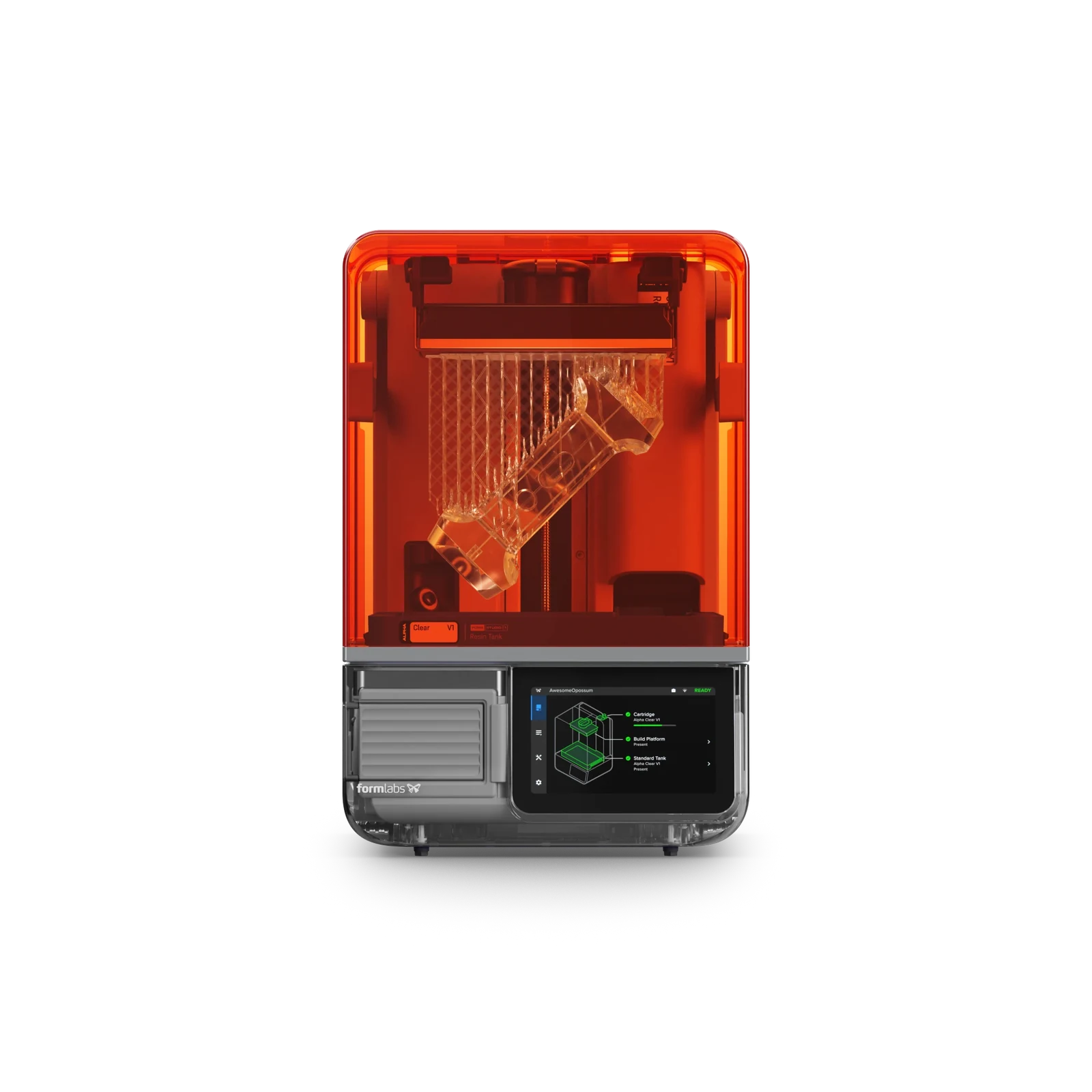
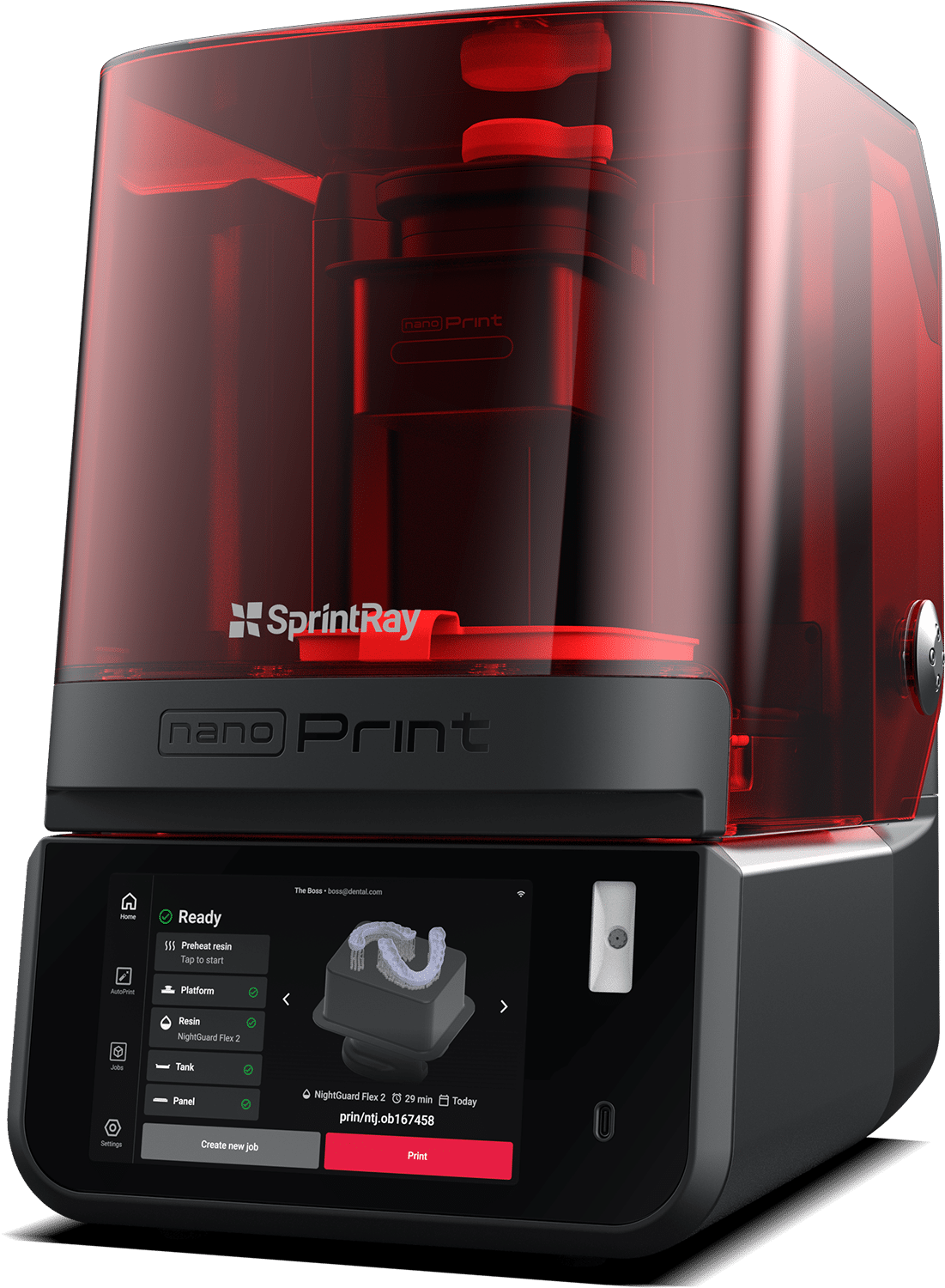
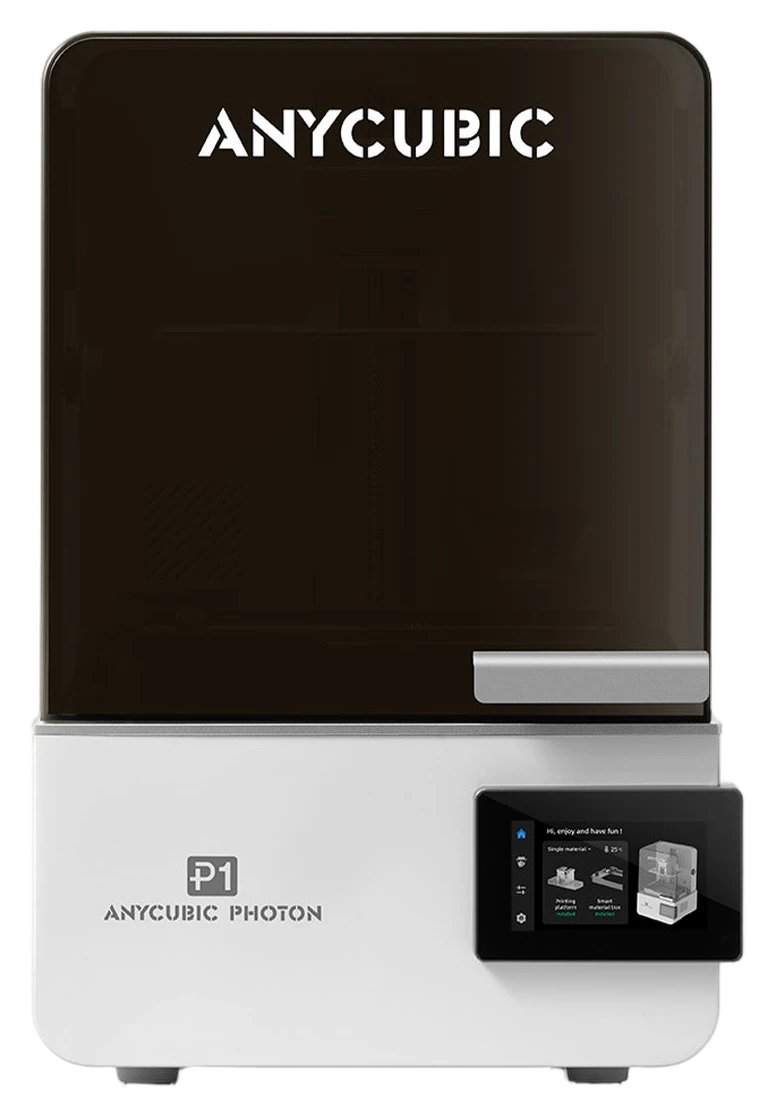
173 printers in the catalog
Profiles in this family, by the process name each manufacturer uses: MSLA (61), DLP (46), SLA (27), Two-photon polymerization (7), PµSL (6), LCM (6), LCD (4), DLS (3), Optical Panel (2), Hybrid Photosynthesis (1), DLP bioprinting (1), Hot Lithography (1), cDLM (1), Lithography-based metal manufacturing (1), LSPc (1), MovingLight DLP (1), Volumetric photopolymerization (1), CPL (1), Digital Press Stereolithography (1), MSLA bioprinting (1).
Common questions
Is SLA the same as resin printing?
Strictly, SLA means laser stereolithography, one of several ways to cure resin. DLP and MSLA printers also cure resin and belong to the same vat photopolymerization family, so SLA is often used loosely for all of them. Formlabs, for example, describes its masked LCD Form 4 as an SLA printer.
Are resin prints stronger than FDM prints?
It depends on the resin. Formlabs says resin parts are more isotropic than extruded parts because layers bond chemically, but standard resins can be brittle. Engineering resins are formulated for toughness, flexibility or heat resistance. Formlabs advises checking data sheets because resins do not behave exactly like nylon or ABS.
Why do resin prints need curing after printing?
The printer only partly cures each layer. Formlabs says some materials need a further dose of light and heat to reach their full mechanical properties, and Loughborough notes that parts often need post-curing to be strong enough for structural use. Wash parts first so uncured resin does not harden on the surface.
How thin are resin printer layers?
Formlabs gives 25 to 200 microns as the typical layer height range for most resin printers. Prusa lists 0.025 to 0.1 mm for its SL1S. Thinner layers reduce visible stepping on curved surfaces but add more layers, and therefore more time, to each print.
Sources
- Additive Manufacturing Technologies NIST · Checked 2026-10-15
- Costs and Cost Effectiveness of Additive Manufacturing (process definitions, section 2.1) NIST · Checked 2026-10-15
- A Comprehensive Overview of Additive Manufacturing Processes Through a Time-Based Classification Model (Koltsaki and Mavri, 2024) 3D Printing and Additive Manufacturing, via PubMed Central · Checked 2026-11-02
- Introduction to 3D printing processes HP · Checked 2026-11-02
- Guide to Stereolithography (SLA) 3D Printing Formlabs · Checked 2026-10-15
- Guide to Resin 3D Printers: SLA vs. DLP vs. MSLA vs. LCD Formlabs · Checked 2026-11-02
- TI DLP Technology for 3D Printing (DLPT019F, revised August 2025) Texas Instruments · Checked 2026-11-02
- Types of printers and their differences Prusa Research · Checked 2026-11-02
- Original Prusa SL1S SPEED 3D printer Prusa Research · Checked 2026-11-02
- VAT Photopolymerisation Loughborough University Additive Manufacturing Research Group · Checked 2026-11-02
An explainer synthesized from the cited references, not hands-on testing. Vendor names for processes are trademarks of their owners and are mapped to the ISO/ASTM 52900 families for orientation.