Two-metal laser powder bed fusion tunes thermal expansion from negative to positive for a satellite experiment
Munich researchers printed lattices of Invar and Inconel 718 in a single build and tuned their thermal expansion from −20 × 10⁻⁶/K to +31 × 10⁻⁶/K.
What happened
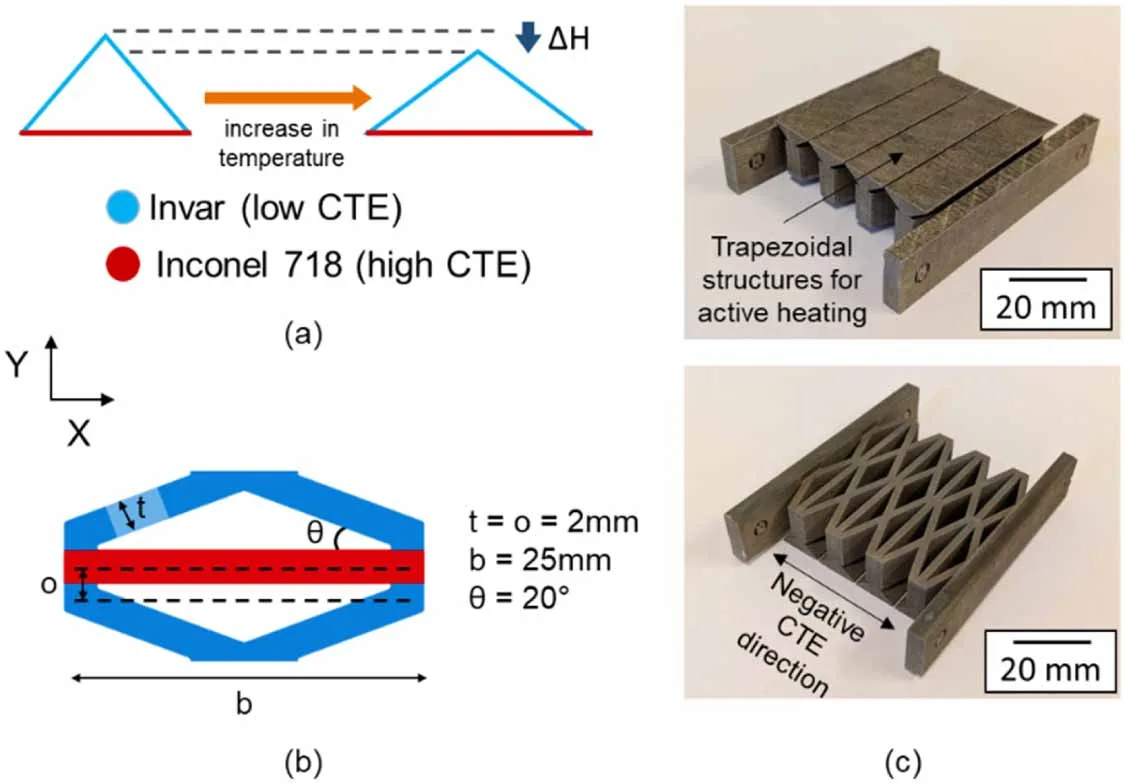
Researchers at the Universität der Bundeswehr München published a study of printed metamaterials with adjustable thermal expansion in Smart Materials and Structures on November 9. Each triangular unit cell pairs Invar, which barely expands when heated, with Inconel 718, which expands more. As the temperature rises the cell bends, which can make the structure shrink. The parts were built on an Aconity3D MIDI+ laser powder bed fusion machine fitted with a Schaeffler Aerosint recoater, which lays down two powders within the same layer at a resolution of 0.5 × 0.5 mm. Both metals were melted with the same parameters in a single scan strategy.
By changing the cell geometry, swapping which metal sits where and combining cell types, the team got expansion coefficients from −20 × 10⁻⁶/K to +31 × 10⁻⁶/K. Measurements by dilatometry and digital image correlation agreed well with simulations. Mixing negative- and positive-expansion cells gave a more stable coefficient than either type alone, and adding a trapezoidal feature for active heating did not change it. In tensile tests, two-metal specimens broke in the weaker Invar rather than at the joint between the metals. Simulations predicted stresses at the joint above Invar’s strength, yet the printed metamaterial showed no damage or plastic deformation after 500 thermal cycles across a 270 °C span.
The structure is intended for an experiment on the SeRANIS satellite mission led by the university; the paper describes laboratory tests and does not report flight results. One specimen of each geometry was printed for the expansion measurements. The authors note that the recoater’s 0.5 mm resolution limits how precisely the boundary between the metals can be placed, though an earlier study found the effect on expansion small. The work was funded through dtec.bw, which is financed by the European Union’s NextGenerationEU programme, and the authors declare no competing interests. The paper is open access under CC BY 4.0, and its data are openly available.
Read the sources
Primary-source reporting; this is not a hands-on review. Sources checked Nov 9, 2026.