Solvent smoothing beat laser, tumbling and filler primer on FDM prints in a Czech comparison
Solvents cut the roughness of ABS and PLA test blocks printed on a Prusa i3 MK3S by up to 99.2%, but filler primer and tumbling cost less once part counts grew.
What happened
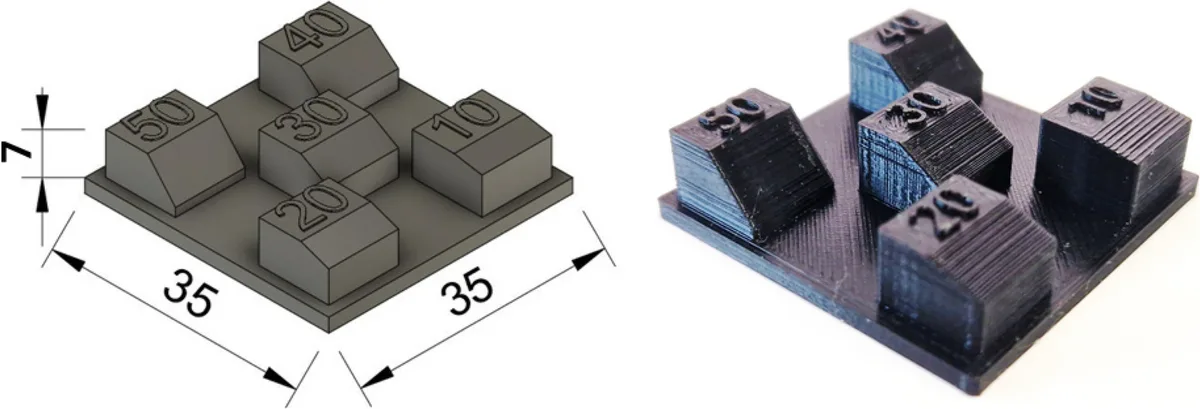
Researchers at Tomas Bata University in Zlín and Brno University of Technology compared four common ways of finishing FDM parts in The International Journal of Advanced Manufacturing Technology on November 9. They printed ABS and PLA test blocks with facets inclined at 10° to 50° on a Prusa i3 MK3S, using a 0.4 mm nozzle and 0.1 mm layers. Each block then got solvent smoothing, a CO₂ laser pass, vibratory tumbling or an acrylic filler primer. ABS sat in acetone vapour for 30 minutes, and PLA was dipped in dichloromethane for 30 seconds. The laser was a Vevor K40 run at about 10 W, tumbling ran for two hours, and the primer went on in two sprayed coats. Nine specimens per condition were measured by optical interferometry.
As printed, surface roughness (Sa) was 10.24–18.92 µm on ABS and 17.88–25.40 µm on PLA. Solvent smoothing brought it down to 0.131–0.191 µm on ABS and 0.248–2.800 µm on PLA, average reductions of 98.88% and 96.01%. The solvent-treated surfaces were significantly smoother than every other method at every angle. The laser cut roughness by about 37.6–51.3% on ABS and 56.6–75.2% on PLA, and the filler primer fell in between. Tumbling was the most variable and generally the least effective, and it chipped some PLA edges. In a side test, Polymaker’s PolySmooth and PolyCast smoothed with alcohol mist in a Polysher averaged reductions of 99.56% and 99.45%. A cost model put the variable cost per part, excluding labour and equipment, at about 1.70, 0.64, 0.57 and 0.25 Czech koruna for solvent, laser, primer and tumbling. Counting equipment and labour, primer was cheapest across low-to-medium volumes, and tumbling only at high volumes.
The authors stress that each method was run at one fixed setting rather than tuned for its best result, with a single nozzle size and layer height, so the ranking does not show each method’s best possible finish. They did not measure dimensional change, strength, residual stress or primer thickness. They also note that the solvents are volatile and hazardous and need ventilation, protective equipment and proper disposal. The work was supported by a research grant (FSI-S-25-8787), and the authors declare no competing interests. The paper is open access under CC BY 4.0.
Read the sources
Primary-source reporting; this is not a hands-on review. Sources checked Nov 9, 2026.