MIT and Northeastern print network-patterned metamaterials that spread impact damage better than lattices
Credit-card-sized polymer samples with beams from microns to centimetres handled compression and weight-drop impacts better than regular lattices and honeycombs.
What happened
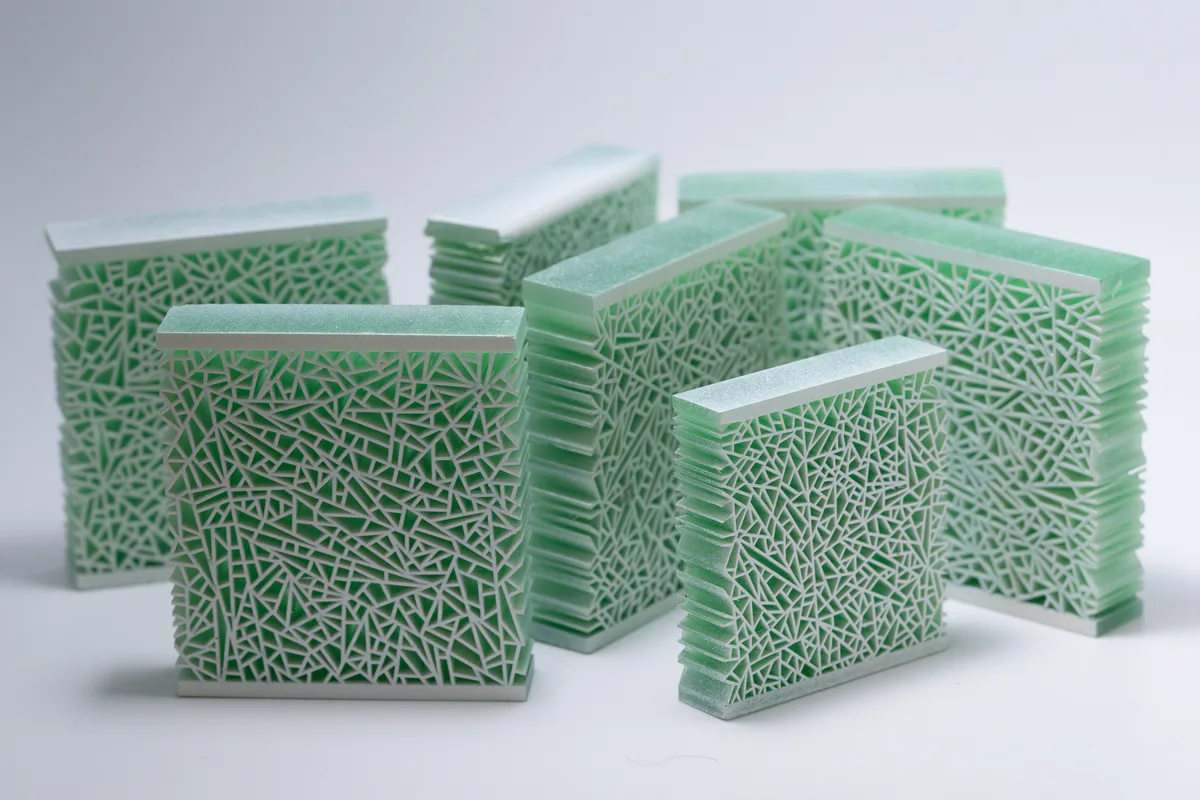
On 11 November 2026 MIT News reported a Nature paper, “Scale-Rich Network-Based Metamaterials”, from MIT’s Carlos Portela and colleagues at MIT, Northeastern University and Utrecht University. Instead of tiling one repeated unit cell, the team generated networks of beams of many sizes, inspired by leaf veins, dragonfly wings and social networks.
An algorithm places a random point, draws a line through it at a random angle, and each later line stops at the domain edge or an earlier line while getting progressively shorter and thinner. Two parameters, starting thickness and how fast it decreases, tune stiffness. The samples were 3D-printed by depositing polymer into the beam patterns, were roughly credit-card sized, and in tests handled compression and weight-drop impacts better than conventional lattice and honeycomb designs. A pomelo-rind-inspired variant with a denser edge cushioned a fragile object at its centre.
The reported tests are laboratory tests on polymer samples only. The MIT article gives no numerical performance figures and no real-world product trials, and the suggested uses (helmets, armour, packaging, acoustic lenses) are the researchers’ outlook. The printer type and material are not specified in the article.
Read the sources
Primary-source reporting; this is not a hands-on review. Sources checked Nov 17, 2026.