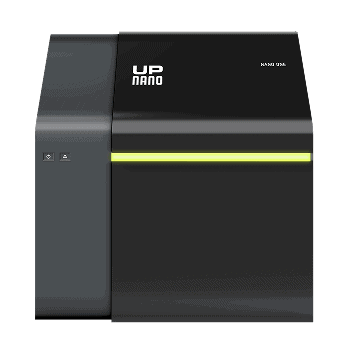
 Two-photon polymerizationManufacturer image: UpNano
UpNano NanoOne Green
Multiphoton lithography system using a green femtosecond laser.
Source reviews: 2026-10-17.
Specifications are reported claims, not independent test results.
The details that matter.
Published specifications for this model. Follow a field's source for its configuration and measurement conditions; older fields refer to the profile's reference list.
| Introduction year | Not verified |
|---|---|
| Model family | NanoOne |
| Process | Two-photon polymerization Sources: NanoOne Green specifications |
| Build envelope (X × Y × Z) | Not verified Stage travel is not a guaranteed printable cuboid; usable printing geometry depends on objectives and substrates. |
| Nominal box volume | Not verified Stage travel is not a guaranteed printable cuboid; usable printing geometry depends on objectives and substrates. |
| Enclosure | Not verified |
| Materials cited in this profile | Photopolymer resin |
| Manufacturer listing status | Manufacturer documentation verified; availability not established |
| Regional stock and price | Check the manufacturer |
| Market grouping | Professional · editorial grouping |
Technical specifications
| Wavelength (nm) | 515 Sources: NanoOne Green specifications |
|---|---|
| Laser Output Power Mw | 400 Sources: NanoOne Green specifications |
| Maximum Stage Travel (mm) | 120, 100, 49 Sources: NanoOne Green specifications |
Design and workflow
Objective selection changes the optical working conditions. Power at the sample is lower than laser output.
Configuration and evidence
Stage travel is not a guaranteed printable cuboid; usable printing geometry depends on objectives and substrates.
Explore the model family.
An exact introduction year has not been established in the reviewed sources.
Family: NanoOne · Listing status only
Explore UpNano through the generationsRead this with the specifications
Stage travel is not a guaranteed printable cuboid; usable printing geometry depends on objectives and substrates.
A larger nominal envelope does not establish better print quality. Fit depends on the configuration, usable area, supports, and orientation.