 Multi-process bioprintingManufacturer image: REGENHU
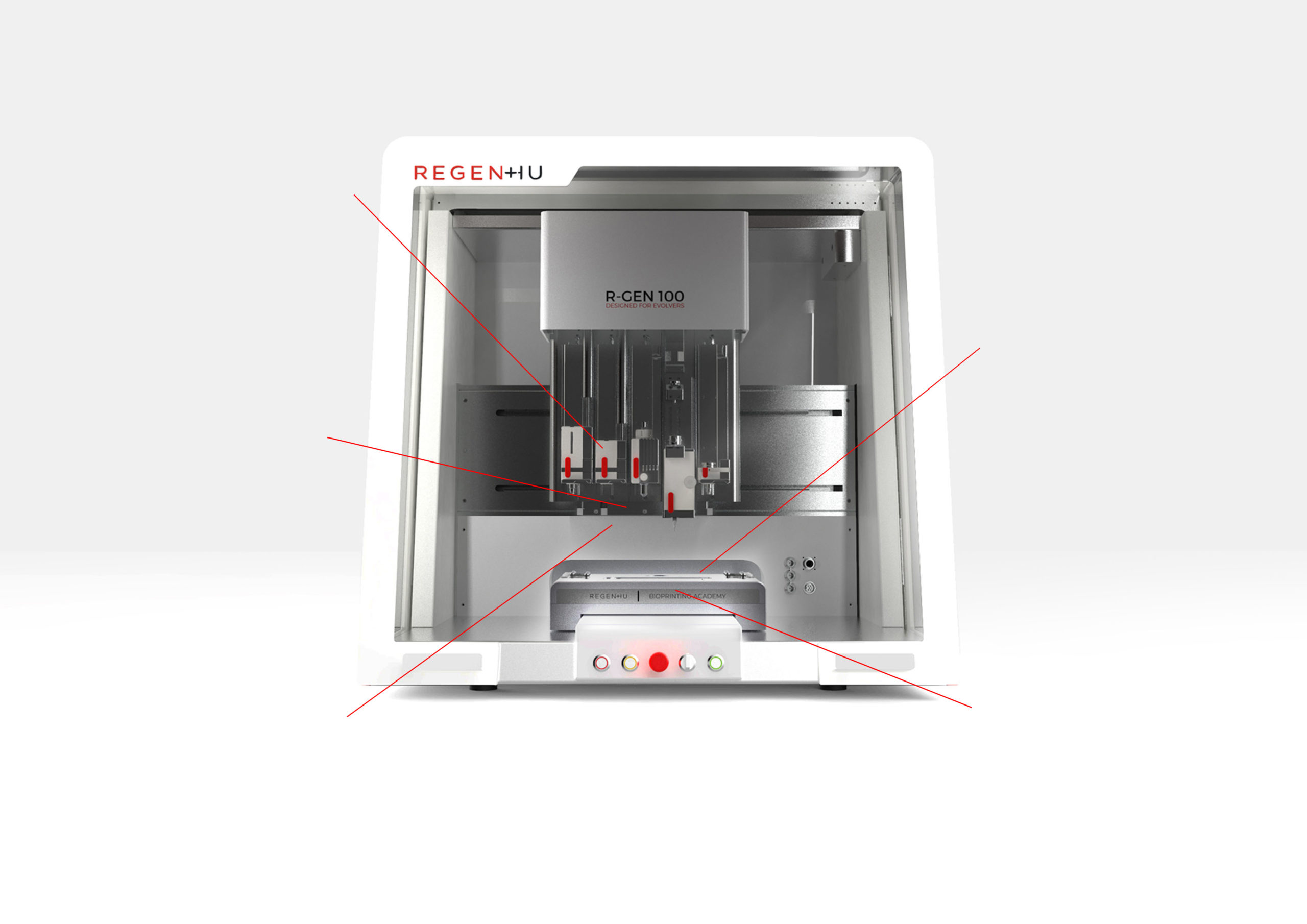
REGENHU R-GEN 100
Configurable biofabrication platform; the selected tools determine the deposition processes.
Source reviews: 2026-10-16.
Specifications are reported claims, not independent test results.
The details that matter.
Published specifications for this model. Follow a field's source for its configuration and measurement conditions; older fields refer to the profile's reference list.
| Introduction year | Not verified |
|---|---|
| Model family | Not verified |
| Process | Multi-process bioprinting |
| Build envelope (X × Y × Z) | 130 × 90 × 65 mm |
| Nominal box volume | 0.76 L · calculated from the envelope |
| Enclosure | Not verified |
| Materials cited in this profile | Bioinks, Biomaterial melts |
| Manufacturer listing status | Manufacturer documentation verified; availability not established |
| Regional stock and price | Check the manufacturer |
| Market grouping | Professional · editorial grouping |
Technical specifications
| Maximum Printing Tools | 5 Maximum capacity; each instrument is configured to order. |
|---|---|
| Workzone Choices | 4 Four available workzone types, not four simultaneous build areas. |
| Machine dimensions (mm) | 770 × 720 × 760 |
| Machine weight (kg) | 160 Published instrument weight. |
| Air Pressure (bar) | 8 |
| Air Quality | ISO 8573-1:2010 [1:4:1] |
| Power Supply | 100–240 VAC, 50–60 Hz |
| Software | R-GEN CONTROLLER, SHAPER |
| Sample Mounting | Vacuum |
| Calibration | Needle and substrate calibration |
| Optional Tools | Pneumatic strand, Pneumatic drop, Pneumatic melt, Volumetric strand |
| Temperature Control | Independent cartridge, nozzle and workzone control |
Configured research instrument
R-GEN combines dispensing tools with interchangeable workzones. Installed tools and auxiliary kits determine whether a setup supports jetting, contact extrusion, electrospinning or electrowriting.
Live process development
The controller allows parameter changes and process interruption during a run. SHAPER handles design and protocol planning, while calibration and process observation support iterative method development.
Explore the model family.
Introduction year has not been established from the reviewed source.
Explore REGENHU through the generationsRead this with the specifications
The model-specific specifications give a maximum 130 × 90 × 65 mm build zone and state that all print tools reach the workzone. Actual deposition methods, temperature capabilities and compatible labware still depend on the ordered tools and workzone kits.
A larger nominal envelope does not establish better print quality. Fit depends on the configuration, usable area, supports, and orientation.